
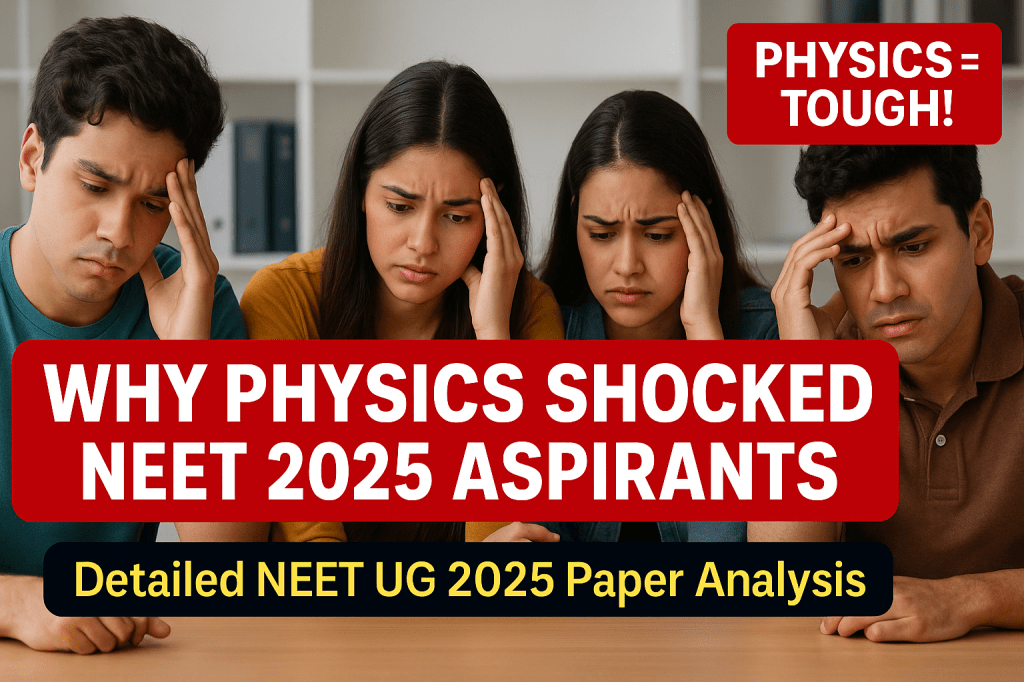
NEET UG 2025 Exam Analysis
Read In English / हिन्दी में पढ़ें
The NEET UG 2025 exam, conducted on May 4 by the National Testing Agency (NTA), witnessed participation from over 22.7 lakh aspirants. This year’s exam was notably more difficult than previous editions, especially in Physics. Students and experts unanimously agreed that NEET 2025 raised the bar in terms of conceptual understanding and analytical skills.
Here’s a pointwise detailed analysis of each subject, with a special focus on why Physics emerged as the toughest section of NEET UG 2025:
📌 General Observations About NEET UG 2025
- The exam followed a pre-Covid pattern, demanding deeper conceptual clarity.
- Only four paper sets were released this year instead of the usual 24, all of which had uniformly difficult questions.
- Overall, the paper was lengthier and more time-consuming, especially due to Physics and Chemistry.
- The level of application-based and multi-conceptual questions increased significantly.
🧠 Physics: The Toughest Section of NEET UG 2025
- Most Challenging Section:
Students across the country rated Physics as the toughest among all three subjects. - Conceptual Depth Required:
The questions weren’t straightforward. They required strong understanding of fundamental concepts and multi-step problem solving. - Heavily Analytical Questions:
Many questions were formula-based but demanded linking concepts across multiple chapters like Mechanics, Electrodynamics, and Thermodynamics. - Time Management Issues:
Due to lengthy calculations and layered problems, time pressure became a major challenge during this section. - Focus on Class 11 Syllabus:
A large chunk of the questions were from Class 11, especially Mechanics, which formed a core part of the section. - No Assertion-Reason or Match-the-Column Format:
Traditional formats like assertion-reason or match-the-column were missing, which students usually depend on for quick scoring. - Topic-wise Question Distribution in Physics:
- Mechanics: 15 questions
- Thermal Physics: 4 questions
- SHM and Waves: 3 questions
- Electrodynamics: 13 questions
- Optics: 4 questions
- Modern Physics and Electronics: 6 questions
- Experimental Skills: 1 question
⚗️ Chemistry: Lengthy and Mixed in Difficulty
- Medium to Difficult Level:
The section had a mix of theoretical and application-based questions with a tilt towards Class 12 topics. - Heavy Emphasis on Organic and Physical Chemistry:
Many questions involved multi-concept application, particularly in Organic Chemistry. - Precision-Based:
Misreading even a single word could lead to mistakes. The need for precision was paramount. - Matrix-Match and Statement-Based Questions:
The section saw several matrix-match and statement-type formats, increasing complexity. - Topic-wise Distribution in Chemistry:
- Physical Chemistry: 16 questions
- Inorganic Chemistry: 12 questions
- Organic Chemistry: 17 questions
- Class 11-based: 22 questions
- Class 12-based: 23 questions
🌿 Biology: NCERT-Based but Lengthy
- Most Manageable Yet Lengthy:
Biology was the least difficult of the three but still lengthy and reading-intensive. - Focus on Class 12 Content:
More questions were sourced from the Class 12 syllabus, with predictable patterns. - Conceptual Understanding Over Rote Learning:
Questions demanded deep reading of NCERT, and some were derived from side notes or introductory content. - Ambiguous Questions Present:
A few questions, such as those on fig-wasp mutualism, were open to interpretation. - Included Diagrams and Complex Formats:
Multi-statement, match-the-column, and assertion-reason questions were widely used. Some questions also required textbook-level diagram recall. - Key Focus Areas in Biology:
- Genetics and Biotechnology were heavily tested.
- Some tricky questions required direct textbook recall, such as the water vascular system.
🧮 Final Takeaway: Why Physics Was the Game-Changer in NEET 2025
- Unlike previous years, Physics this year demanded high-level analytical thinking and cross-topic application.
- The absence of typical easy formats (like assertion-reason) meant students couldn’t rely on shortcuts.
- The calculation-intensive nature led to poor time management for many students.
- Students who focused only on formula memorization struggled to apply concepts contextually.
📊 Expected Impact on Results
- The overall difficulty spike, especially in Physics, is likely to lower the number of top scorers.
- Students with strong fundamentals and problem-solving skills will have an edge.
- Cut-offs might see moderate drops due to the challenging nature of Physics and Chemistry.
Conclusion:
NEET UG 2025 proved to be a turning point in terms of exam design. Physics, often dreaded by aspirants, took the spotlight this year as the most formidable hurdle. Students preparing for NEET UG in future years must now focus on conceptual mastery, multi-topic integration, and extensive practice of analytical questions to excel.
NEET UG 2025 परीक्षा विश्लेषण: इस साल छात्रों को क्यों लगा कि फिजिक्स सबसे कठिन विषय था?
Read In English / हिन्दी में पढ़ें
NEET UG 2025 परीक्षा 4 मई को National Testing Agency (NTA) द्वारा आयोजित की गई, जिसमें 22.7 लाख से अधिक मेडिकल अभ्यर्थियों ने भाग लिया। इस वर्ष का पेपर पिछली बार की तुलना में कहीं अधिक कठिन माना गया, विशेष रूप से Physics सेक्शन ने छात्रों की सबसे अधिक परीक्षा ली। छात्रों और विशेषज्ञों दोनों का मानना है कि इस बार का पेपर अवधारणात्मक समझ और एनालिटिकल स्किल्स पर अधिक आधारित था।
यहाँ पर NEET UG 2025 का विषयवार विश्लेषण बिंदुवार रूप में प्रस्तुत है, खासतौर पर यह समझाने के लिए कि Physics इस बार क्यों सबसे कठिन रहा:
📌 NEET UG 2025 की मुख्य विशेषताएँ:
- यह परीक्षा Pre-Covid Pattern पर आधारित थी जिसमें गहराई से अवधारणात्मक स्पष्टता की आवश्यकता थी।
- इस बार केवल चार पेपर सेट जारी किए गए, जबकि पहले 24 सेट हुआ करते थे — सभी सेट समान रूप से कठिन थे।
- पूरा पेपर लंबा और समय लेने वाला रहा, विशेष रूप से Physics और Chemistry के कारण।
- प्रश्नों में Application-Based और Multi-Conceptual Approach अधिक देखने को मिली।
🧠 Physics: NEET UG 2025 का सबसे कठिन सेक्शन
- सबसे चुनौतीपूर्ण विषय:
सभी विषयों में से छात्रों ने Physics को सबसे कठिन बताया। - गहरी अवधारणात्मक समझ की आवश्यकता:
प्रश्न सीधे नहीं थे — सटीक कॉन्सेप्ट क्लैरिटी और मल्टी-स्टेप प्रोसेसिंग की आवश्यकता थी। - एनालिटिकल और लॉजिकल प्रश्न:
अधिकांश प्रश्न फॉर्मूला आधारित थे लेकिन उत्तर तक पहुँचने के लिए कई चरणों से गुजरना पड़ा। - समय प्रबंधन बड़ी चुनौती:
लंबी गणनाओं और कॉन्सेप्ट जोड़ने वाले सवालों ने टाइम मैनेजमेंट को कठिन बना दिया। - Class 11 पर अधिक फोकस:
Physics के अधिकतर प्रश्न Class 11 से आए, विशेष रूप से Mechanics पर आधारित। - आसान फॉर्मेट्स की गैरमौजूदगी:
इस बार Assertion-Reason या Match-the-Column जैसे सरल फॉर्मेट नहीं थे। - Physics में टॉपिक-वाइज प्रश्न वितरण:
- Mechanics: 15 प्रश्न
- Thermal Physics: 4 प्रश्न
- SHM & Waves: 3 प्रश्न
- Electrodynamics: 13 प्रश्न
- Optics: 4 प्रश्न
- Modern Physics & Electronics: 6 प्रश्न
- Experimental Skills: 1 प्रश्न
⚗️ Chemistry: लंबा और जटिल सेक्शन
- मध्यम से कठिन स्तर:
थ्योरी आसान थी लेकिन Application-Based प्रश्नों ने सेक्शन को कठिन बनाया। - Organic और Physical Chemistry पर ज़ोर:
कई प्रश्नों में एक से अधिक कॉन्सेप्ट को जोड़कर उत्तर निकालना पड़ा। - सटीकता की आवश्यकता:
ज़रा सी चूक से गलत उत्तर मिल सकते थे — सावधानीपूर्वक पढ़ना जरूरी था। - Matrix-Match और Statement-Based प्रश्न:
पेपर में ऐसे कई प्रश्न थे जो काफी समय लेने वाले और जटिल थे। - Chemistry में टॉपिक-वाइज प्रश्न वितरण:
- Physical Chemistry: 16 प्रश्न
- Inorganic Chemistry: 12 प्रश्न
- Organic Chemistry: 17 प्रश्न
- Class 11 से: 22 प्रश्न
- Class 12 से: 23 प्रश्न
- Class 11: Physical (9), Inorganic (5), Organic (8)
- Class 12: Physical (7), Inorganic (7), Organic (9)
🌿 Biology: अपेक्षाकृत आसान लेकिन लंबा सेक्शन
- कम कठिन लेकिन विस्तृत:
Biology सेक्शन अपेक्षाकृत कम जटिल था लेकिन बहुत अधिक पढ़ने योग्य था। - Class 12 पर अधिक जोर:
अधिकांश प्रश्न Class 12 NCERT से लिए गए थे और पैटर्न अपेक्षित था। - गहरी समझ का मूल्यांकन:
केवल रटने से काम नहीं चला — कई प्रश्न NCERT के अंदरूनी हिस्सों जैसे इंट्रोडक्शन या प्रोफाइल से आए। - कुछ अस्पष्ट प्रश्न:
जैसे fig-wasp relationship जैसे प्रश्न अस्पष्ट और व्याख्या-आधारित थे। - डायग्राम और कठिन फॉर्मेट शामिल:
Assertion-Reason, Match-the-Column, Multi-Statement जैसे प्रश्नों का प्रभावी उपयोग किया गया। - मुख्य फोकस टॉपिक्स:
- Genetics और Biotechnology पर विशेष ध्यान।
- कुछ प्रश्नों में Textbook Level Recall की आवश्यकता थी (जैसे water vascular system)।
🧮 अंतिम निष्कर्ष: Physics क्यों बना सबसे बड़ी चुनौती?
- इस बार Physics में ज्यादा Analytical Thinking और Inter-Topic Application की माँग थी।
- आसान प्रश्न पैटर्न नहीं थे, जिससे छात्रों को ज़्यादा सोचना पड़ा।
- लंबे कैलकुलेशन और समय प्रबंधन ने स्कोरिंग को कठिन बना दिया।
- केवल फॉर्मूला याद करके आए छात्रों को संकल्पनात्मक प्रश्नों में परेशानी हुई।
📊 रिजल्ट पर संभावित प्रभाव:
- Physics और Chemistry की कठिनाई के कारण टॉप स्कोरर की संख्या घट सकती है।
- जिन छात्रों की कंसेप्ट क्लैरिटी और लॉजिकल अप्रोच बेहतर थी, उन्हें लाभ मिलेगा।
- कट-ऑफ में संभवतः हल्की गिरावट देखी जा सकती है।
निष्कर्ष:
NEET UG 2025 ने यह स्पष्ट कर दिया कि अब परीक्षा सिर्फ रटना नहीं, बल्कि सोचना, समझना और जोड़कर हल करना है। Physics ने इस साल यह चुनौती दी कि अब NEET केवल याद रखने की परीक्षा नहीं है, बल्कि एक अभ्यास और सिद्धांत की गहराई की परीक्षा है। आने वाले वर्षों के अभ्यर्थियों को चाहिए कि वे अपने बेसिक्स को मजबूत करें, और प्रैक्टिस व एनालिसिस पर ज़ोर दें।
Read More





 The Bachchantop
Leave a comment