
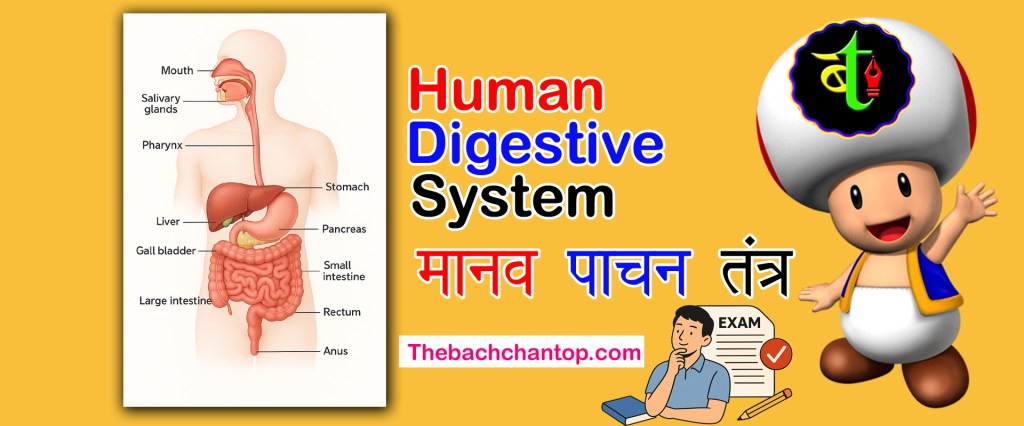
The Human Digestive System is one of the most important topics in Biology. It explains how our body converts complex food into simple, absorbable nutrients to provide energy, growth, and repair. This system involves several organs working together — from the mouth to the anus — each performing a specific function in the digestion process.
🧠 Definition and Meaning
The digestive system is the group of organs responsible for ingesting food, digesting it into simpler forms, absorbing nutrients, and eliminating waste from the body.
⚙️ Main Functions of Digestive System
- Ingestion – Taking food into the mouth.
- Digestion – Breaking down complex food into simple substances (mechanical and chemical).
- Absorption – Nutrients pass into the bloodstream through intestinal walls.
- Assimilation – Utilization of absorbed nutrients by body cells for energy and growth.
- Egestion – Elimination of undigested food as feces through the anus.
🧩 Table: Parts of the Human Digestive System
| S.N. | Name of Part | Function |
|---|---|---|
| 1 | Mouth (Buccal cavity) | Ingestion of food and chewing (mastication) with help of teeth and saliva |
| 2 | Salivary glands | Secrete saliva containing enzyme salivary amylase (acts on starch) |
| 3 | Pharynx | Connects mouth to esophagus; pathway for food and air |
| 4 | Esophagus (Food pipe) | Transports food to stomach by peristalsis |
| 5 | Stomach | Secretes HCl and pepsin; protein digestion begins; food turns into chyme |
| 6 | Liver | Produces bile which helps in fat digestion; largest gland |
| 7 | Gall bladder | Stores and releases bile into small intestine |
| 8 | Pancreas | Secretes pancreatic juice containing enzymes for protein, carbohydrate, and fat digestion |
| 9 | Small intestine | Main site of digestion and absorption of nutrients; contains villi |
| 10 | Large intestine | Absorbs water and minerals; forms feces |
| 11 | Rectum and Anus | Temporary storage and ejection of feces |

👉 Also Read: Human Respiratory System Notes
🔬 Process of Digestion (Step-by-Step)
1. In the Mouth
- Food is chewed by teeth and mixed with saliva.
- Salivary amylase converts starch into maltose.
- Tongue helps in mixing and swallowing (deglutition).
2. In the Esophagus
- No digestion occurs.
- Food is pushed toward the stomach by peristaltic movement.
3. In the Stomach
- Secretes gastric juice containing:
- Hydrochloric acid (HCl) – kills bacteria and activates pepsin.
- Pepsin enzyme – breaks proteins into peptones.
- Mucus – protects stomach lining from acid.
- Food becomes semi-liquid chyme.
4. In the Small Intestine
- Receives bile (from liver) and pancreatic juice (from pancreas).
- Bile emulsifies fats.
- Pancreatic enzymes:
- Trypsin → acts on proteins.
- Amylase → acts on starch.
- Lipase → acts on fats.
- Intestinal juice completes digestion into amino acids, glucose, and fatty acids.
- Nutrients are absorbed through villi into the bloodstream.
5. In the Large Intestine
- Absorbs water, minerals, and some vitamins.
- Remaining waste forms feces, stored in rectum, and expelled through anus.
🧾 Important Digestive Enzymes and Their Functions
| Enzyme | Source | Action | End Product |
|---|---|---|---|
| Salivary amylase | Salivary glands | Starch → Maltose | Maltose |
| Pepsin | Stomach | Protein → Peptones | Peptones |
| Trypsin | Pancreas | Peptones → Amino acids | Amino acids |
| Lipase | Pancreas | Fats → Fatty acids + Glycerol | Simple fats |
| Maltase, Sucrase, Lactase | Small intestine | Disaccharides → Monosaccharides | Glucose, Fructose, Galactose |
📚 Board Exam-Oriented Questions and Answers
Short Answer Type Questions
Q1. Define digestion.
→ The process of breaking down complex food into simpler absorbable forms is called digestion.
Q2. Name the largest gland in the human body.
→ Liver.
Q3. What is the function of bile?
→ Bile helps in emulsification of fats and neutralizes stomach acid.
Q4. What are villi? What is their function?
→ Villi are small finger-like projections in the small intestine that increase the surface area for absorption of nutrients.
Q5. Name the enzymes present in pancreatic juice.
→ Trypsin, Amylase, and Lipase.
Long Answer Type Questions
Q1. Explain the process of digestion of food in the human body.
→ Food is first ingested through the mouth, chewed by teeth, and mixed with saliva. The food passes through the esophagus to the stomach, where proteins are partially digested by pepsin. In the small intestine, bile emulsifies fats, and pancreatic enzymes digest carbohydrates, proteins, and fats completely. The digested food is absorbed by villi, while undigested food passes to the large intestine and finally excreted through the anus.
Q2. Describe the role of liver and pancreas in digestion.
→ The liver secretes bile that emulsifies fats, making them easy to digest. The pancreas secretes pancreatic juice containing enzymes—trypsin, amylase, and lipase—which help in the digestion of proteins, carbohydrates, and fats respectively.
Q3. What are the five steps of nutrition in humans?
→ Ingestion, Digestion, Absorption, Assimilation, and Egestion.
👉 Also Read: Human Respiratory System Notes
Multiple Choice Questions (MCQs)
- The enzyme that digests starch in the mouth is –
a) Pepsin b) Trypsin c) Amylase ✅ d) Lipase - Which organ stores bile?
a) Liver ✅ b) Gall bladder c) Pancreas d) Stomach - The end product of protein digestion is –
a) Glucose b) Fatty acids ✅ c) Amino acids d) Water - Which part of the alimentary canal absorbs water?
a) Stomach b) Small intestine ✅ c) Large intestine d) Mouth - Which part of the small intestine mainly absorbs nutrients?
✅ Jejunum and Ileum
💡 General Knowledge and Awareness Section
- The length of the human alimentary canal is about 9 meters.
- The small intestine alone is about 6 meters long.
- The digestive system works with enzymes, hormones, and nerves to regulate digestion.
- The first step of digestion begins in the mouth with saliva, not in the stomach.
🌿 Tips to Keep Digestive System Healthy
- Eat fiber-rich food like fruits, vegetables, and whole grains.
- Drink plenty of water to aid digestion and prevent constipation.
- Chew food properly to ease stomach function.
- Avoid overeating and eat at regular intervals.
- Limit junk food and oily meals.
- Exercise regularly to maintain good metabolism.
- Manage stress, as anxiety can affect digestion.
- Get enough sleep, which helps body processes including digestion.
- Include probiotics (curd, yogurt) for healthy gut bacteria.
- Avoid smoking and alcohol, which damage digestive organs.
📘 Summary
- Human digestive system converts food into energy through a coordinated process involving mouth, stomach, intestine, and glands.
- Enzymes and juices play crucial roles in digestion and absorption.
- Good digestive health is essential for overall well-being and energy balance.


 The Bachchantop
Leave a comment