
1. Introduction
- An equation involving one variable and having maximum power 2 is called a quadratic equation.
- Quadratic equations are widely used in algebra, geometry, physics, and daily life problems.
- The word quadratic comes from the Latin word “quadratus”, meaning square.
2. Standard Form of a Quadratic Equation
- A quadratic equation in variable x is written as:
ax² + bx + c = 0 - Where:
- a, b, c are real numbers
- a ≠ 0
- If a = 0, the equation becomes linear, not quadratic.
3. Examples of Quadratic Equations
- x² + 5x + 6 = 0
- 2x² − 7x + 3 = 0
- x² − 4 = 0
- (x − 3)(x + 2) = 0
Not Quadratic Equations
- 3x + 5 = 0 (linear equation)
- x³ − 2x + 1 = 0 (degree 3)
4. Roots of a Quadratic Equation
- The solutions of a quadratic equation are called its roots.
- Roots are the values of x which satisfy the equation.
- A quadratic equation can have two roots (may be equal or different).
5. Methods of Solving Quadratic Equations (NCERT)
Quadratic equations can be solved by the following three methods:
(A) Factorisation Method
- Express the quadratic equation as a product of two linear factors.
- Set each factor equal to zero.
- Find the values of x.
Steps:
- Write equation in standard form.
- Factorise the middle term.
- Equate each factor to zero.
- Solve for x.
(B) Completing the Square Method
- Convert the equation into a perfect square.
- Useful when factorisation is difficult.
Steps:
- Divide the equation by coefficient of x² (if not 1).
- Move constant term to RHS.
- Add square of half the coefficient of x on both sides.
- Solve the resulting equation.
(C) Quadratic Formula Method
- Used when equation is not easily factorisable.
- The quadratic formula is:
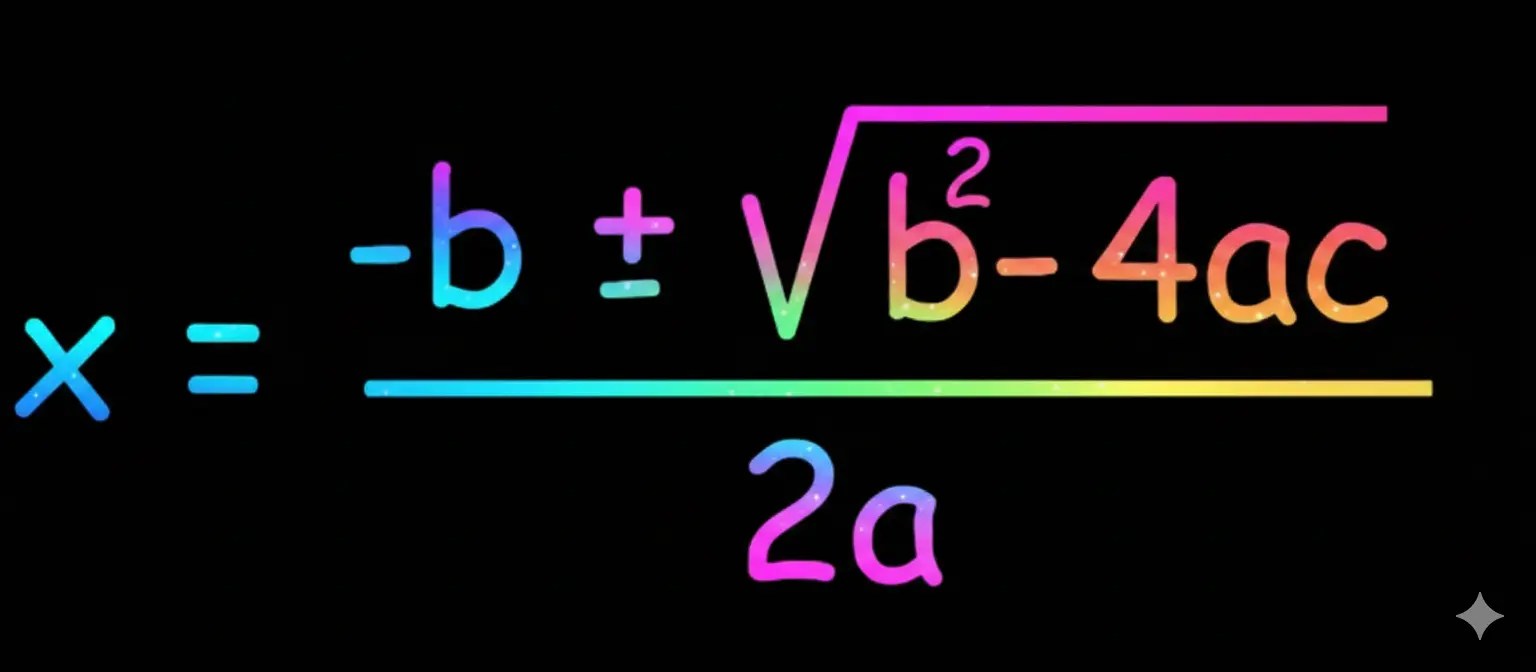
- Substitute values of a, b, c and simplify.
6. Discriminant
- The expression b² − 4ac is called the discriminant.
- Discriminant is denoted by D.
D = b2 – 4ac
7. Nature of Roots Based on Discriminant
| Value of D | Nature of Roots |
|---|---|
| D > 0 | Two distinct real roots |
| D = 0 | Two equal real roots |
| D < 0 | No real roots |
8. Geometrical Meaning of Quadratic Equation
- The graph of a quadratic equation represents a parabola.
- The roots are the points where the parabola cuts the x-axis.
- If the parabola:
- Cuts x-axis at two points → two real roots
- Touches x-axis at one point → equal roots
- Does not touch x-axis → no real roots
9. Solution of a Quadratic Equation
- A quadratic equation may have:
- Two real solutions
- One real solution (repeated)
- No real solution
10. Applications of Quadratic Equations
Quadratic equations are used to solve problems related to:
- Area and perimeter
- Speed, time, and distance
- Number problems
- Age problems
- Geometrical figures
- Product and sum of numbers
11. Important NCERT Points to Remember
- Standard form: ax² + bx + c = 0
- a ≠ 0 is compulsory
- Roots are obtained by factorisation, completing square, or quadratic formula
- Discriminant decides the nature of roots
- Quadratic formula is the most general method
12. Important Formulas
- Quadratic Formula:
- Discriminant:
D = b2 – 4ac
13. Common Mistakes to Avoid
- Taking a = 0 in quadratic equation
- Wrong calculation of discriminant
- Sign errors in quadratic formula
- Incorrect factorisation
14. Quick Revision Summary
- Degree of quadratic equation = 2
- Maximum number of roots = 2
- Discriminant determines root nature
- Graph is always a parabola
- Quadratic formula works for all quadratic equations
 The Bachchantop
Leave a comment