
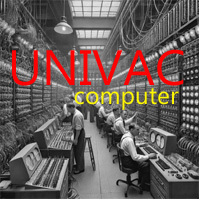
- UNIVAC : Universal Automatic Computer
- 1. Introduction to UNIVAC
- 2. History and Development
- 3. Key Specifications of UNIVAC
- 4. Purpose and Applications
- 5. Working Mechanism of UNIVAC
- 6. Programming and Control
- 7. Limitations of UNIVAC
- 8. Transition from UNIVAC to Modern Computers
- 9. Impact and Legacy
- 10. Interesting Facts about UNIVAC
- 11. Conclusion
- UNIVAC : Universal Automatic Computer(हिन्दी में पढ़ें)
UNIVAC : Universal Automatic Computer
1. Introduction to UNIVAC
- Full Form: Universal Automatic Computer
- Developed by J. Presper Eckert and John W. Mauchly, the same inventors who created ENIAC.
- UNIVAC was the first commercial, general-purpose electronic digital computer designed for business and administrative use.
- Officially delivered to the United States Census Bureau in 1951.
2. History and Development
- Developed by Eckert-Mauchly Computer Corporation (EMCC), later acquired by Remington Rand.
- Project initiated in 1946 and completed in 1951.
- The first UNIVAC I (UNIVAC-1) was installed and operational at the U.S. Census Bureau on June 14, 1951.
- UNIVAC gained public attention by accurately predicting the outcome of the 1952 U.S. presidential election.
3. Key Specifications of UNIVAC
- Size: Occupied around 14 x 8 feet of space.
- Weight: Approximately 13 tons.
- Components:
- 5,200 vacuum tubes
- 18,000 crystal diodes
- 300 relays
- Memory: Used mercury delay line memory with a capacity of 1,000 words of 12 characters each.
- Input/Output: Used magnetic tape and punched cards for data input and output.
- Speed: Performed around 1,000 additions per second.
4. Purpose and Applications
- Designed primarily for business, administrative, and scientific calculations.
- Applications included:
- U.S. Census data processing
- Payroll and accounting systems
- Inventory management
- Weather forecasting
- Simulations for nuclear research
5. Working Mechanism of UNIVAC
- Used binary-coded decimal (BCD) arithmetic.
- Memory relied on mercury delay lines, where acoustic pulses were transmitted and received through mercury tubes to store data.
- Input was fed through punched cards or magnetic tape, and the results were printed.
- Could handle both numeric and alphanumeric data.
6. Programming and Control
- UNIVAC programming used machine language initially.
- Later, assembly languages and higher-level languages were introduced for easier programming.
- Magnetic tape systems enabled batch processing and faster data handling.
7. Limitations of UNIVAC
- High Cost: Priced at around $1 million, making it accessible only to large organizations.
- Size and Power: Required a large space and consumed significant power.
- Maintenance Issues: Frequent breakdowns due to vacuum tube failures.
- Limited Storage Capacity: Memory capacity was small compared to modern standards.
8. Transition from UNIVAC to Modern Computers
- Introduction of Magnetic Core Memory: Replaced mercury delay lines, offering faster and more reliable storage.
- Introduction of Transistors: Reduced size and power consumption while increasing reliability.
- Successor Models:
- UNIVAC II: Introduced improvements in speed and reliability.
- UNIVAC 1103: Introduced as a scientific computing system.
9. Impact and Legacy
- Marked the beginning of the era of commercial computing.
- Played a pivotal role in introducing computers for business and government applications.
- Inspired the development of subsequent generations of computers.
- Demonstrated the power of computing in data processing and decision-making.
10. Interesting Facts about UNIVAC
- UNIVAC predicted a landslide victory for Dwight D. Eisenhower in the 1952 U.S. presidential election with 99.6% accuracy.
- It was the first computer to be widely recognized by the public due to its media coverage.
- The first 46 UNIVAC I units were sold to government agencies and large corporations.
11. Conclusion
UNIVAC revolutionized commercial computing by demonstrating the potential of digital computers in business and administrative applications. Though it had limitations, its success paved the way for future advancements in computer technology, leading to the development of smaller, faster, and more powerful systems that have become integral to modern life.
UNIVAC : Universal Automatic Computer(हिन्दी में पढ़ें)
1. UNIVAC का परिचय
- पूरा नाम: Universal Automatic Computer
- जे. प्रेपर एकर्ट और जॉन डब्ल्यू मौचली द्वारा विकसित, जिन्होंने पहले ENIAC का निर्माण किया था।
- UNIVAC पहला व्यावसायिक, जनरल-पर्पज इलेक्ट्रॉनिक डिजिटल कंप्यूटर था, जिसे व्यापार और प्रशासनिक कार्यों के लिए डिज़ाइन किया गया।
- 14 जून 1951 को इसे संयुक्त राज्य जनगणना ब्यूरो (U.S. Census Bureau) को आधिकारिक रूप से सौंपा गया।
2. इतिहास और विकास
- इसे Eckert-Mauchly Computer Corporation (EMCC) द्वारा विकसित किया गया, जिसे बाद में Remington Rand ने अधिग्रहित कर लिया।
- परियोजना की शुरुआत 1946 में हुई और 1951 में पूरी हुई।
- पहला UNIVAC I (UNIVAC-1) 14 जून 1951 को U.S. Census Bureau में स्थापित और संचालित हुआ।
- UNIVAC ने 1952 के अमेरिकी राष्ट्रपति चुनाव के परिणाम की सटीक भविष्यवाणी कर के वैश्विक ध्यान आकर्षित किया।
3. UNIVAC की प्रमुख विशेषताएं
- आकार: लगभग 14 x 8 फीट जगह घेरता था।
- वजन: लगभग 13 टन।
- प्रमुख घटक:
- 5,200 वैक्यूम ट्यूब
- 18,000 क्रिस्टल डायोड
- 300 रिले
- मेमोरी: मरकरी डिले लाइन मेमोरी का उपयोग किया गया, जिसमें 1,000 शब्दों की क्षमता थी, प्रत्येक शब्द में 12 अक्षर होते थे।
- इनपुट/आउटपुट: डेटा इनपुट और आउटपुट के लिए चुंबकीय टेप और पंच कार्ड का उपयोग किया गया।
- गति: प्रति सेकंड लगभग 1,000 जोड़ करने की क्षमता।
4. उद्देश्य और अनुप्रयोग
- मुख्य रूप से व्यावसायिक, प्रशासनिक और वैज्ञानिक गणनाओं के लिए डिज़ाइन किया गया।
- अनुप्रयोगों में शामिल थे:
- अमेरिकी जनगणना डेटा प्रसंस्करण
- पेरोल और लेखा प्रणाली
- इन्वेंटरी प्रबंधन
- मौसम पूर्वानुमान
- परमाणु अनुसंधान के लिए सिमुलेशन
5. UNIVAC का कार्य करने का तरीका
- बाइनरी-कोडेड डेसिमल (BCD) अंकगणित का उपयोग करता था।
- मेमोरी मरकरी डिले लाइन्स पर आधारित थी, जहां ध्वनि तरंगों को मरकरी ट्यूब में भेजकर और प्राप्त करके डेटा संग्रहीत किया जाता था।
- इनपुट पंच कार्ड या चुंबकीय टेप के माध्यम से किया जाता था, और परिणाम प्रिंट आउट के रूप में मिलते थे।
- यह संख्यात्मक और अल्फान्यूमेरिक दोनों प्रकार के डेटा को संभाल सकता था।
6. प्रोग्रामिंग और नियंत्रण
- प्रारंभ में मशीन लैंग्वेज का उपयोग कर प्रोग्रामिंग की जाती थी।
- बाद में असेंबली लैंग्वेज और उच्च-स्तरीय भाषाओं को विकसित किया गया, जिससे प्रोग्रामिंग आसान हो गई।
- चुंबकीय टेप सिस्टम ने बैच प्रोसेसिंग और तेज डेटा हैंडलिंग को संभव बनाया।
7. UNIVAC की सीमाएं
- उच्च लागत: कीमत लगभग $1 मिलियन थी, जो केवल बड़ी संस्थाओं के लिए ही सुलभ थी।
- आकार और ऊर्जा खपत: बहुत बड़ी जगह घेरता था और अत्यधिक ऊर्जा खपत करता था।
- रखरखाव की समस्या: वैक्यूम ट्यूब की बार-बार खराबी के कारण अक्सर ब्रेकडाउन होता था।
- सीमित स्टोरेज क्षमता: आधुनिक मानकों की तुलना में मेमोरी क्षमता बहुत कम थी।
8. UNIVAC से आधुनिक कंप्यूटर तक का विकास
- मैग्नेटिक कोर मेमोरी की शुरुआत: मरकरी डिले लाइनों की जगह ली, जिससे तेज और अधिक विश्वसनीय भंडारण संभव हुआ।
- ट्रांजिस्टर का विकास: आकार और ऊर्जा खपत को कम किया और विश्वसनीयता बढ़ाई।
- उत्तराधिकारी मॉडल:
- UNIVAC II: गति और विश्वसनीयता में सुधार के साथ पेश किया गया।
- UNIVAC 1103: वैज्ञानिक गणनाओं के लिए विकसित किया गया।
9. प्रभाव और विरासत
- व्यावसायिक कंप्यूटिंग के युग की शुरुआत की।
- व्यापार और सरकारी कार्यों के लिए कंप्यूटर के उपयोग की नींव रखी।
- भविष्य में कंप्यूटर प्रौद्योगिकी के विकास को प्रेरित किया।
- डेटा प्रसंस्करण और निर्णय लेने में कंप्यूटिंग की शक्ति को सिद्ध किया।
10. UNIVAC से जुड़े रोचक तथ्य
- UNIVAC ने 1952 के अमेरिकी राष्ट्रपति चुनाव में ड्वाइट डी. आइजनहावर की भारी जीत की 99.6% सटीक भविष्यवाणी की।
- यह पहला कंप्यूटर था जिसे सार्वजनिक रूप से व्यापक मान्यता मिली।
- पहले 46 UNIVAC I यूनिट्स को सरकारी एजेंसियों और बड़ी कंपनियों को बेचा गया।
11. निष्कर्ष
UNIVAC ने व्यावसायिक कंप्यूटिंग में क्रांति ला दी और डिजिटल कंप्यूटरों की शक्ति को व्यावसायिक और प्रशासनिक अनुप्रयोगों में सिद्ध किया। इसकी सीमाओं के बावजूद, यह आधुनिक कंप्यूटरों के विकास में एक महत्वपूर्ण कदम साबित हुआ, जिसने हमारे वर्तमान डिजिटल युग की शुरुआत की।
Learn More About Computer Science




















Something went wrong. Please refresh the page and/or try again.

 The Bachchantop
Leave a comment