
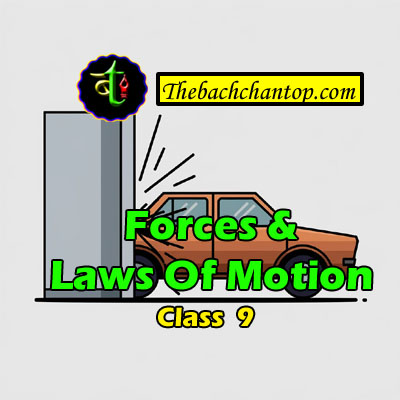
🧲 Chapter 8 : Force and Laws of Motion – Class 9 (NCERT)
🔹 1. Force
- A force is a push or pull that can change the state of motion or shape of an object.
- It has both magnitude and direction, hence it is a vector quantity.
- Unit of Force: Newton (N) in SI units.
- Effects of force:
- Can change the speed of an object.
- Can change the direction of motion.
- Can change the shape or size of an object.
🔹 2. Balanced and Unbalanced Forces
- Balanced Forces:
- Do not cause any change in the state of motion of an object.
- Net force is zero.
- Unbalanced Forces:
- Cause a change in the state of motion (i.e., velocity or direction).
- Net force is not zero.
🔹 3. Newton’s First Law of Motion (Law of Inertia)
- An object remains in its state of rest or uniform motion in a straight line unless acted upon by an external unbalanced force.
- This law defines inertia — the natural tendency of objects to resist a change in their state of motion or rest.
- More mass → more inertia.
🔹 4. Newton’s Second Law of Motion
- The rate of change of momentum of an object is directly proportional to the applied unbalanced force and takes place in the direction of the force.
🔹 Formula:
- F = m × a
- Where:
- F = Force (in newtons, N)
- m = Mass (in kg)
- a = Acceleration (in m/s²)
- Where:
- Momentum (p) = m × v
- p = Momentum (in kg·m/s)
- m = Mass (in kg)
- v = Velocity (in m/s)
- Change in momentum = Final momentum − Initial momentum
- Δp = m × v − m × u
- F = (m × v − m × u) / t
- F = m × (v − u) / t
🔹 5. Newton’s Third Law of Motion
- For every action, there is an equal and opposite reaction.
- Action and reaction forces act on different bodies and are equal in magnitude but opposite in direction.
🔹 6. Conservation of Momentum
- In the absence of an external force, the total momentum of two or more interacting bodies remains constant.
🔹 Formula:
- If two bodies with masses m₁ and m₂, initial velocities u₁ and u₂, final velocities v₁ and v₂:
- m₁ × u₁ + m₂ × u₂ = m₁ × v₁ + m₂ × v₂
- This is based on Newton’s Third Law and Second Law combined.
🔹 7. Inertia
- Inertia is the property of a body to resist a change in its state of motion or rest.
- Types of Inertia:
- Inertia of Rest
- Inertia of Motion
- Inertia of Direction
- More mass = More inertia
🔹 8. Application-Based Examples
- A passenger moves forward when a bus stops suddenly (Inertia of Motion).
- A hanging ball stays at rest until pushed (Inertia of Rest).
- Jumping on a trampoline (Action-Reaction).
- Gun recoiling when fired (Conservation of Momentum).
Would you like this in a PDF format or need practice questions and numerical problems as well?

Buy Best Refference Books For Class 9th
| Subject | Buy Link |
|---|---|
| Mathematics | Click to Buy |
| Science | Click to Buy |
| English | Click to Buy |
| Social Science | Click to Buy |
| Hindi | Click to Buy |
अध्याय 8 – बल तथा गति के नियम (Force and Laws of Motion)
🧲 1. बल (Force)
- बल एक धक्का या खींचाव होता है जो किसी वस्तु की गति या आकार को बदल सकता है।
- बल एक सदिश राशि (Vector Quantity) है, इसका परिमाण (Magnitude) और दिशा (Direction) दोनों होते हैं।
- SI इकाई (Unit): न्यूटन (Newton – N)
- बल के प्रभाव:
- वस्तु की गति बढ़ा सकता है या धीमा कर सकता है।
- गति की दिशा बदल सकता है।
- वस्तु के आकार या रूप को बदल सकता है।
🔹 2. संतुलित व असंतुलित बल (Balanced & Unbalanced Force)
- संतुलित बल:
- वस्तु की गति की स्थिति में कोई परिवर्तन नहीं करता।
- कुल बल (Net Force) = 0 होता है।
- असंतुलित बल:
- वस्तु की गति को बदलता है (गति या दिशा)।
- कुल बल ≠ 0 होता है।
🔹 3. न्यूटन का पहला नियम (Newton’s First Law – जड़त्व का नियम)
- कोई भी वस्तु तब तक विश्राम की अवस्था में या समान गति से गतिशील रहती है, जब तक उस पर कोई बाहरी असंतुलित बल कार्य न करे।
- यह नियम वस्तुओं की जड़त्व (Inertia) की प्रवृत्ति को बताता है – अर्थात कोई वस्तु अपनी गति की स्थिति में बदलाव का विरोध करती है।
- अधिक द्रव्यमान (Mass) वाली वस्तु में अधिक जड़त्व होता है।
🔹 4. न्यूटन का दूसरा नियम (Newton’s Second Law of Motion)
- किसी वस्तु का संवेग परिवर्तन की दर (Rate of change of momentum) उस पर लगने वाले बल के अनुपाती होती है और यह बल उसी दिशा में होता है।
🔹 सूत्र (Formulas):
- F = m × a
(F = बल, m = द्रव्यमान, a = त्वरण) - Momentum (p) = m × v
(p = संवेग, m = द्रव्यमान, v = वेग) - F = (m × v − m × u) / t
या
F = m × (v − u) / t
🔹 5. न्यूटन का तीसरा नियम (Newton’s Third Law)
- प्रत्येक क्रिया के लिए एक समान और विपरीत प्रतिक्रिया होती है।
- क्रिया और प्रतिक्रिया बल अलग-अलग वस्तुओं पर कार्य करते हैं।
🔹 6. संवेग संरक्षण का नियम (Law of Conservation of Momentum)
- जब दो वस्तुएँ आपस में टकराती हैं और कोई बाहरी बल कार्य नहीं करता, तो उनका कुल संवेग स्थिर (Constant) रहता है।
🔹 सूत्र (Formula):
- m₁ × u₁ + m₂ × u₂ = m₁ × v₁ + m₂ × v₂
(जहाँ m = द्रव्यमान, u = प्रारंभिक वेग, v = अंतिम वेग)
🔹 7. जड़त्व (Inertia)
- जड़त्व वह प्रवृत्ति है जिसमें कोई वस्तु अपने विश्राम या गति की अवस्था को बनाए रखना चाहती है।
- तीन प्रकार के जड़त्व:
- विश्राम का जड़त्व (Inertia of Rest)
- गति का जड़त्व (Inertia of Motion)
- दिशा का जड़त्व (Inertia of Direction)
🔹 8. दैनिक जीवन से उदाहरण (Real-Life Examples)
- बस के अचानक रुकने पर यात्री आगे झुक जाते हैं (गति का जड़त्व)।
- चलती गेंद को अचानक रोकने में बल लगता है (बल का प्रभाव)।
- बंदूक चलाने पर पीछे की ओर झटका लगता है (संवेग संरक्षण)।
- गुब्बारा हवा छोड़ने पर विपरीत दिशा में उड़ता है (क्रिया-प्रतिक्रिया)।
Buy Best Refference Books For Class 9th
| Subject | Buy Link |
|---|---|
| Mathematics | Click to Buy |
| Science | Click to Buy |
| English | Click to Buy |
| Social Science | Click to Buy |
| Hindi | Click to Buy |










 The Bachchantop
Leave a comment