

हिन्दी में पढ़ने के लिए यहाँ क्लिक करें
We Will Learn
- Electric Charges in Our Day-to-Day Life
- 🔑 Important Terms and Definitions
- Electrostatic Charges
- What is Electric Charge?
- What is the unit of Electric Charge?
- What are the types of charges?
- What are the properties of Charges?
- What are the Conductors, Insulators and Dielectrics?
- What is Gold Leaf Electroscope (GLE)?
- How are electric charges produced?
- What is the origin of electric charge?
- What is quantization of electric charge?
- What is Coulomb’s Law?
- What is dielectric constant or relative electrical permittivity?
- What is Electrostatic unit of charge? what is stat coulomb?
- What is electromagnetic Unit of charge?
- What is principle of superposition for forces between multiple charges?
- What is Continuous charge distribution?
- Electrostatic Field
- What is Electrostatic Field?
- What is electric field intensity?
- What is the relation between Electric Field Intensity and Force?
- Explain physical significance of electric field.
- What are electric field lines?
- What are the properties of electric field lines?
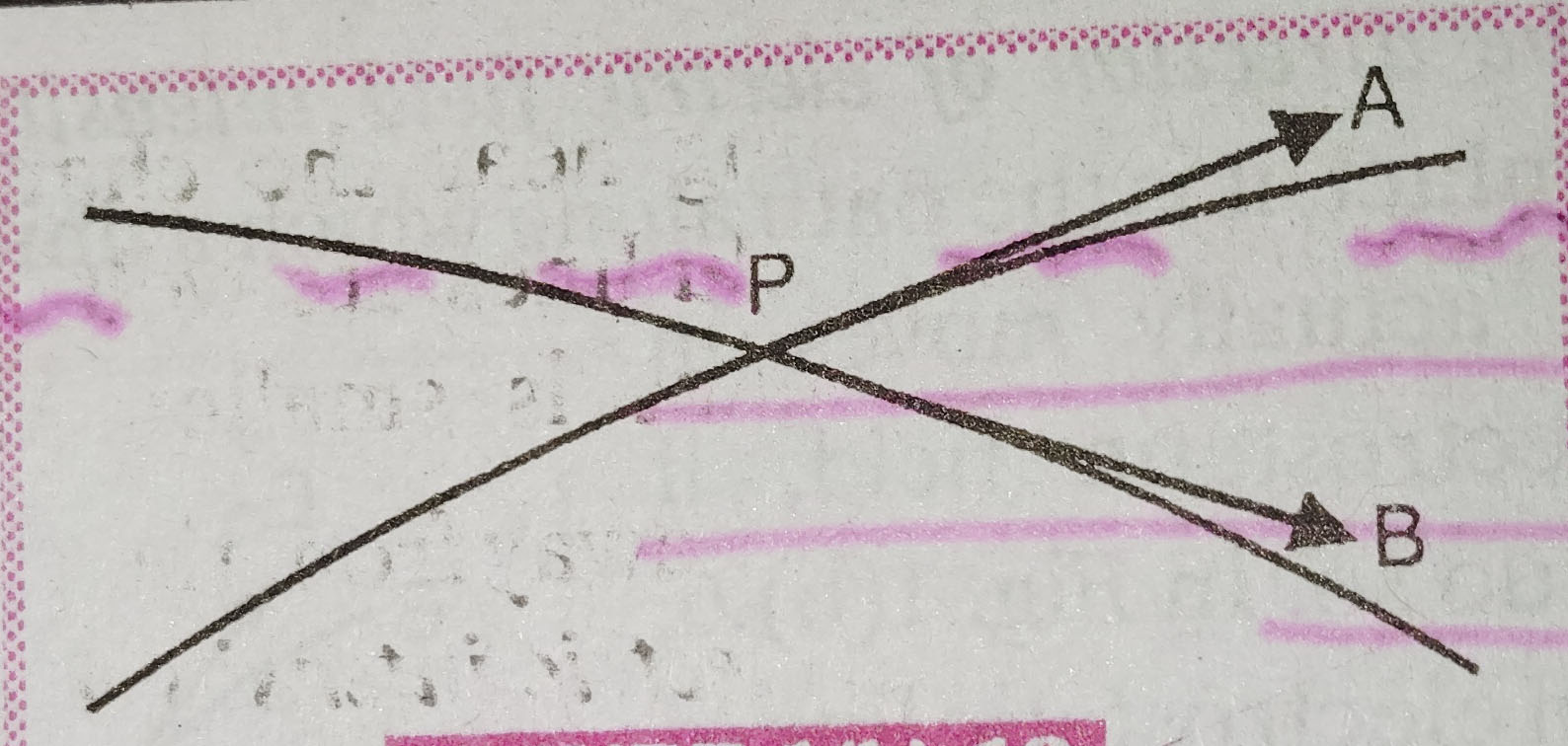
- Why two electric field lines never intersect each other?
- What is electric dipole?
- What is electric dipole moment?
- What is physical significance of electric dipole?
- What is dipole field?
- 1. On the axial line (along the dipole axis):
- 2. On the equatorial line (perpendicular to the dipole axis):
- Electric Field intensity on axial line of electric dipole
- Electric Field intensity on equatorial line of electric dipole
- Electric Field Intensity at Any Point Due to a Short Electric Dipole
- Electric field intensity at any point on the axis of a uniformly charged ring
- Torque on electric dipole in a uniform two dimensional electric field
- Potential energy of dipole in a uniform electric field
- Important Constants
Electric Charges in Our Day-to-Day Life
Electric charge is present everywhere — from natural phenomena like lightning to technoCharges in Our Day-to-Day Lifelogies like photocopiers and biological processes in our body. Understanding charge helps us make sense of the physical world.
Electric charges are not just theoretical concepts; they are all around us. Many common phenomena in our daily life can be explained using the concept of electric charge.

🔹 1. Static Electricity
- When we rub a balloon on our hair, it sticks to the wall — due to static charge.
- Rubbing certain materials (like plastic, wool, or glass) transfers electrons, making them charged.
🔹 2. Electric Shock from Metal Objects
- When you walk on a carpet and then touch a doorknob, you might feel a small electric shock.
- This is due to build-up of static charge on your body, which discharges when you touch a conductor.
🔹 3. Lightning and Thunder
- During thunderstorms, clouds get electrically charged due to friction between air and water droplets.
- When the electric potential becomes large, a discharge occurs as lightning — a natural example of massive electrostatic breakdown.
🔹 4. Photocopiers and Laser Printers
- These devices use electrostatic charges to attract toner particles onto paper in the desired pattern.
🔹 5. Comb and Paper Trick
- After combing dry hair, the comb can attract small pieces of paper.
- This happens because the comb gets charged by friction and induces opposite charge in paper pieces.
🔹 6. Dust on TV or Computer Screens
- CRT monitors or TVs get slightly charged, attracting dust particles from the air.
🔹 7. Painting and Spraying
- In electrostatic painting, paint droplets are charged and sprayed. The object is oppositely charged, improving efficiency and reducing waste.
🔹 8. Air Purifiers and Chimneys
- Use electrostatic precipitators to remove particles and pollutants by charging them and attracting them to oppositely charged plates.
🔹 9. Clothes Clinging After Washing
- Clothes rubbed against each other in a dryer develop static charge and stick together.
🔹 10. Biological Systems
- The nervous system transmits signals via movement of ions (charged particles) across cell membranes.
- Every cell has a resting membrane potential due to charge separation.
🔑 Important Terms and Definitions
- Charge (विद्युत आवेश): A fundamental property of matter due to which it experiences electric force. Measured in coulombs (C).
- Coulomb (C): SI unit of electric charge.
- Quantization of Charge: Charge exists in discrete packets, i.e., q = ±ne, where e = 1.6 × 10⁻¹⁹ C.
- Conservation of Charge: Total charge in an isolated system remains constant.
- Conductors: Materials that allow electric charges to move freely (e.g., copper, silver).
- Insulators: Materials that do not allow electric charges to move freely (e.g., rubber, glass).
- Coulomb’s Law: Describes the electrostatic force between two point charges.
- Electric Field (E): The region around a charge where its influence is felt by other charges.
- Electric Field Lines: Imaginary lines representing direction and strength of electric field.
- Electric Dipole: A pair of equal and opposite charges separated by a small distance.
- Dipole Moment (p): A vector quantity defined as p = q × 2a.
Electrostatic Charges
What is Electric Charge?
Electric charge is a fundamental property of matter due to which it experiences a force when placed in an electric field. It is the source of all electric and electromagnetic interactions.
Symbol: q or Q
SI Unit: Coulomb (C)
Nature: Scalar quantity
Types of charge:
- Positive charge (e.g., proton)
- Negative charge (e.g., electron)
Properties of electric charge:
- Quantization: Charge exists in discrete units. Smallest charge is e = 1.6 × 10⁻¹⁹ C. Any charge q = n·e, where n is an integer.
- Conservation: Total charge in an isolated system remains constant.
- Additivity: Total charge is algebraic sum of individual charges.
- Like charges repel, unlike charges attract.
- Invariance: Charge is independent of the observer’s frame of reference.
Common charges:
- Electron: –1.6 × 10⁻¹⁹ C
- Proton: +1.6 × 10⁻¹⁹ C
- Neutron: 0 C (neutral)
What is the unit of Electric Charge?
The SI unit of electric charge is Coulomb (C).
1 Coulomb is defined as the amount of charge transported by a current of 1 ampere in 1 second.
Relation with current:
Q = I × t
where,
Q = charge (in coulombs)
I = current (in amperes)
t = time (in seconds)
Smaller units:
- 1 millicoulomb (mC) = 10⁻³ C
- 1 microcoulomb (μC) = 10⁻⁶ C
- 1 nanocoulomb (nC) = 10⁻⁹ C
Elementary charge:
e = 1.6 × 10⁻¹⁹ C (charge on one electron or proton)
What are the types of charges?
There are two types of electric charges:
- Positive Charge (+):
- Carried by protons.
- Deficiency of electrons in a body causes positive charge.
- Like charges repel each other.
- Negative Charge (–):
- Carried by electrons.
- Excess of electrons in a body causes negative charge.
- Opposite charges attract each other.
Important:
- Neutral objects have equal number of positive and negative charges.
- Charge is always transferred by electrons, not protons.
What are the properties of Charges?
Properties of electric charge:
- Quantization of Charge:
Charge exists in discrete units. Any charge q=n⋅eq = n \cdot e, where
e=1.6×10⁻¹⁹ Ce = 1.6 \times 10^{-19} \, C and nn is an integer. - Conservation of Charge:
Total charge in an isolated system remains constant. Charge can neither be created nor destroyed. - Additivity of Charge:
Charges add algebraically. Total charge is the sum of individual charges. - Attraction and Repulsion:
Like charges repel, unlike charges attract. - Invariance of Charge:
Charge is independent of the observer’s frame of reference and remains unchanged in all inertial frames. - Charge is a Scalar Quantity:
It has magnitude only, no direction. - Transferability of Charge:
Charge can be transferred from one body to another, usually through electrons.
What are the Conductors, Insulators and Dielectrics?
Conductors, Insulators, and Dielectrics:
- Conductors:
- Materials that allow electric charge (electrons) to flow freely.
- Free electrons are present.
- Charge resides only on the surface.
- Examples: Copper, Silver, Aluminum, Human body, Saltwater.
- Insulators:
- Materials that do not allow electric charge to flow.
- No free electrons.
- Charge cannot move inside or on the surface.
- Examples: Rubber, Plastic, Wood, Glass, Dry air.
- Dielectrics:
- Insulators that can be polarized when placed in an electric field.
- Electric dipoles are induced.
- Used in capacitors to increase capacitance.
- Examples: Mica, Glass, Distilled water, Ceramic.
Difference between Insulator and Dielectric:
- All dielectrics are insulators, but not all insulators are suitable as dielectrics.
- Dielectrics respond to electric field by polarization; general insulators may not.
What is Gold Leaf Electroscope (GLE)?
Gold Leaf Electroscope (GLE):
A gold leaf electroscope is a simple device used to detect the presence and nature of electric charge on a body.
Construction:
- A metal rod is mounted vertically through an insulating cork in a glass container.
- At the lower end of the rod, two thin gold leaves are attached.
- At the top, a metal disc or knob is fixed to receive charge.
- The glass case protects the leaves from air currents.
Working Principle:
- Based on the principle of like charges repel each other.
- When a charged object touches or comes near the metal disc, the charge spreads to the leaves.
- The gold leaves get similarly charged and repel, causing them to diverge.
- The degree of divergence indicates the magnitude of charge.
Uses:
- To detect presence of charge.
- To determine type of charge (positive or negative) using known charge.
- To test whether a body is conductor or insulator.
- To show electrostatic induction.
Limitations:
- Cannot measure exact amount of charge.
- Very sensitive to air and humidity.
How are electric charges produced?
Production of Electric Charges:
Electric charges can be produced by the following methods:
- Friction (Rubbing):
- When two different materials are rubbed together, electrons get transferred from one to the other.
- One becomes positively charged (loses electrons), and the other becomes negatively charged (gains electrons).
- Example: Rubbing a glass rod with silk.
- Conduction (Contact Method):
- When a charged body touches a neutral conductor, some charge is transferred.
- Both bodies acquire the same type of charge.
- Example: Touching a charged rod to a metal sphere.
- Induction:
- A charged body brought near a neutral conductor induces opposite charge on the near side and same charge on the far side without touching.
- Then grounding can make the conductor permanently charged.
- Example: Bringing a charged rod near an electroscope.
- Photoelectric Effect:
- When light of sufficient frequency falls on a metal surface, electrons are ejected, leaving behind a positive charge.
- Used in photo cells.
- Thermionic Emission:
- On heating certain metals, electrons gain enough energy to escape, leaving the object positively charged.
- Electrochemical Method:
- Electric charges are produced during chemical reactions, such as in batteries (electrolytic cells).
What is the origin of electric charge?
Origin of Electric Charge:
Electric charge is a fundamental property of certain subatomic particles. It is not derived from any other physical quantity — rather, it is a basic intrinsic property of matter, like mass.
- Electron carries a negative charge of −1.6×10⁻¹⁹ C-1.6 \times 10^{-19} \, C
- Proton carries a positive charge of +1.6×10⁻¹⁹ C+1.6 \times 10^{-19} \, C
- Neutron has no charge (neutral)
Origin at atomic level:
- In an atom, electrons (negative) revolve around the nucleus, which contains protons (positive) and neutrons.
- Normally, the number of protons = number of electrons → atom is neutral.
- Gain or loss of electrons → atom becomes charged (ion).
Key Point:
The electric charge arises due to the existence and imbalance of electrons and protons in matter. It is a naturally occurring, conserved, and quantized property.
What is quantization of electric charge?
Quantization of Electric Charge:
Quantization of electric charge means that charge exists in discrete packets, not in a continuous manner. Any charge qq on a body is always an integral multiple of the elementary charge (e).
Mathematically, q=n⋅e
where,
q = total charge
n = any integer (positive or negative)
e=1.6×10⁻¹⁹
Key Points:
- Charge cannot exist in fractions of e; only as e,2e,3e,…e, 2e, 3e …….
- This is valid for all macroscopic objects.
- At subatomic level (like quarks), fractional charges exist, but they are never isolated.
Conclusion:
Electric charge is quantized, meaning it always appears in whole-number multiples of a fundamental unit e.
What is Coulomb’s Law?
Coulomb’s Law:
Coulomb’s law states that the electrostatic force between two point charges is:
- Directly proportional to the product of their charges, and
- Inversely proportional to the square of the distance between them.

Mathematical form:
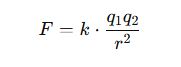
Where,
F = Electrostatic force (in newtons)
q1,q2 = Magnitudes of the two charges (in coulombs)
r = Distance between the charges (in meters)
k = Coulomb’s constant
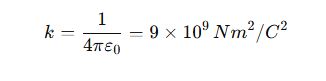
Key points:
- Force acts along the line joining the charges.
- Force is repulsive if charges are like, and attractive if charges are unlike.
- Valid only for point charges in vacuum or air.
What is dielectric constant or relative electrical permittivity?
Dielectric constant or relative electrical permittivity is the ratio of the permittivity of a medium (ε) to the permittivity of vacuum (ε₀). It tells us how much the medium reduces the electrostatic force between two charges as compared to vacuum.
εr = ε/ε0
Where,
εr = Dielectric constant (unitless)
ε = Permittivity of the medium
ε0=8.85×10⁻¹² C2/Nm2(Permittivity of vacuum)
Key points:
- εr ≥1 for all materials
- εr=1 for vacuum or air
- A higher εr means greater ability of the medium to reduce force.
- Used in capacitors to increase capacitance by placing a dielectric material between plates.
What is Electrostatic unit of charge? what is stat coulomb?
Electrostatic unit of charge (esu) is the unit of charge in the CGS (centimeter-gram-second) electrostatic system. It is also called statcoulomb (statC).
In this system, the force between two point charges is given by: F = q1q2 / r2
where, F is in dynes, r in cm, and q in esu.
Definition:
1 statcoulomb is the amount of charge that, when placed 1 cm apart from an equal and similar charge in vacuum, repels it with a force of 1 dyne.
Conversion to SI unit: 1 statC=3.33564×10⁻¹⁰ C
Key Points:
- Statcoulomb is used in theoretical and classical electrostatics.
- It is not used in practical measurements, where Coulomb (SI unit) is preferred.
What is electromagnetic Unit of charge?
Electromagnetic Unit of Charge (emu) is the unit of charge in the CGS electromagnetic (CGS-emu) system. It is based on magnetic interactions rather than electrostatic ones.
Definition:
1 emu of charge is the amount of charge that, when moving with a velocity of 1 cm/s in a conductor, produces a magnetic force of 1 dyne per cm between two parallel wires 1 cm apart carrying equal currents.
Unit: abC or abampere-second (also called abcoulomb)
Relation with SI unit: 1 abC=10 C
Key Points:
- EMU is used in the CGS electromagnetic system, mostly for magnetic field-related calculations.
- It is much larger than 1 coulomb.
- Not used in modern SI-based practical systems.
What is principle of superposition for forces between multiple charges?
Principle of Superposition for Forces Between Multiple Charges:
According to the superposition principle, when multiple charges are present, the net electrostatic force on any one charge is the vector sum of the individual forces exerted on it by all other charges, considered one at a time.
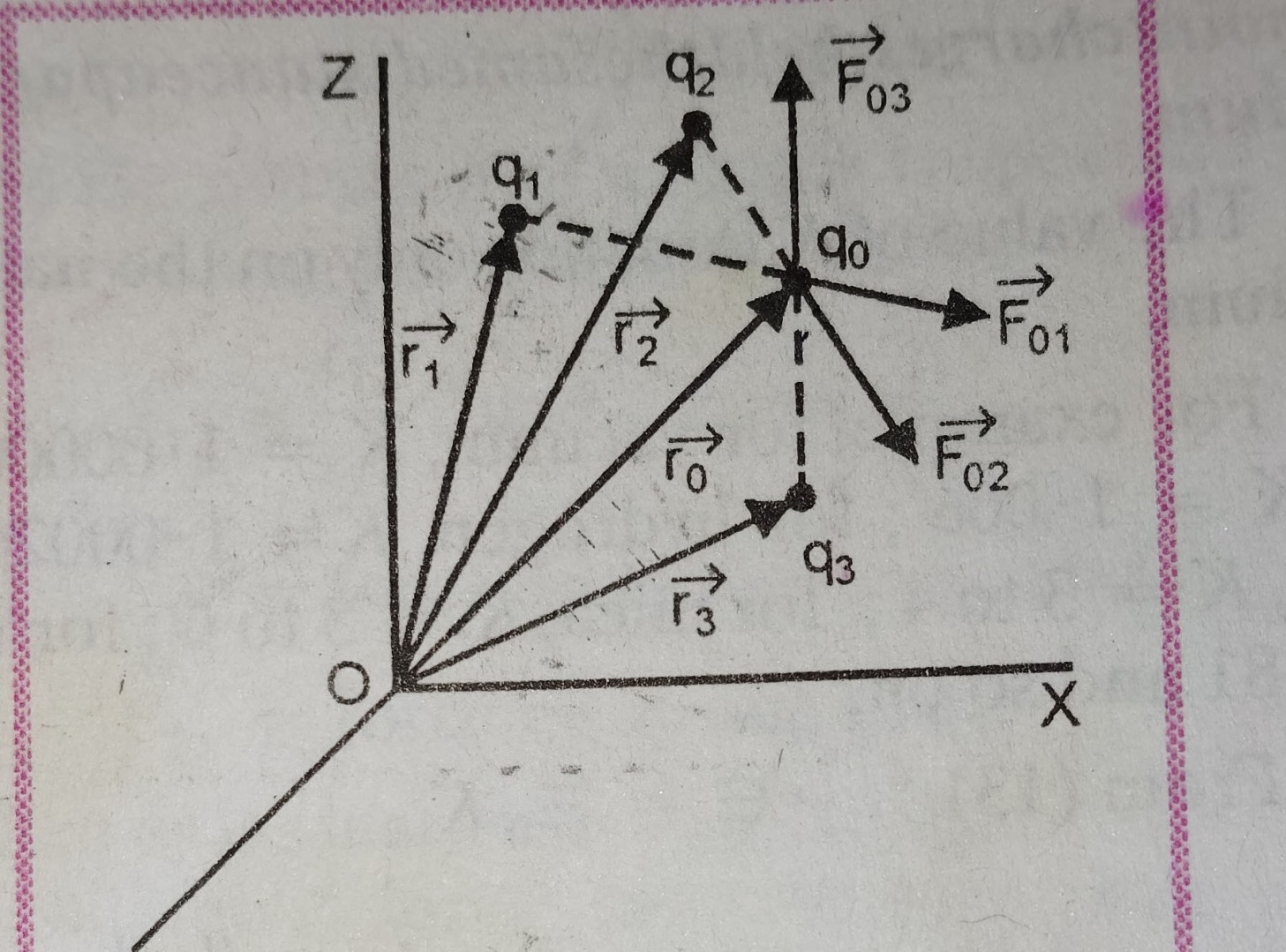
Mathematically:
If a charge q experiences forces F1,F2,F3,… due to other charges q1,q2,q3,… then the net force is: Fnet=F1+F2+F3+…
Key Points:
- Each force is calculated using Coulomb’s law.
- Direction and magnitude must be considered using vector addition.
- Valid only for electrostatic (non-moving) point charges.
- Forces act independently and do not alter each other.
What is Continuous charge distribution?
Continuous Charge Distribution:
When electric charge is spread over an object in such a way that it appears uniformly distributed throughout its volume, surface, or length, it is called a continuous charge distribution. Instead of dealing with individual point charges, the distribution is considered as a smooth function over space.

Depending on how the charge is distributed, it is of three types:
- Linear Charge Distribution
- Charge distributed along a line (e.g., wire)Described by Linear charge density (λ)
- Surface Charge Distribution
- Charge spread over a surface (e.g., sheet or plate)Described by Surface charge density (σ)
- Volume Charge Distribution
- Charge distributed throughout a volume (e.g., sphere or cube)Described by Volume charge density (ρ)
Key Point:
In such distributions, total charge is calculated by integrating over the length, area, or volume:
q=∫dq
Electrostatic Field
What is Electrostatic Field?
Electrostatic Field:
An electrostatic field is the region around a stationary electric charge in which other charges experience an electric force. It is a vector field that represents the influence that a stationary charge exerts on other charges in its vicinity.

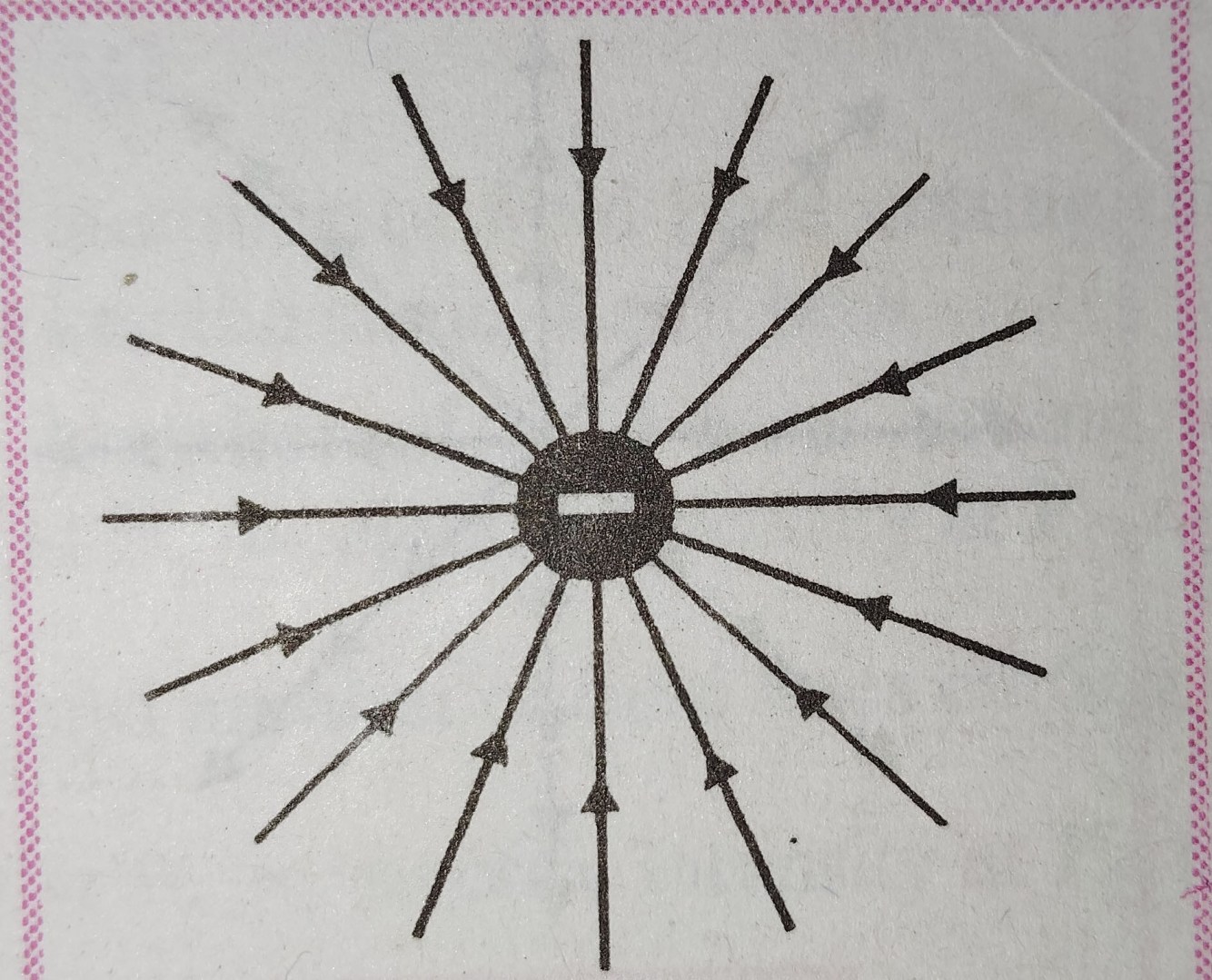
Mathematically, the electric field E at a point is defined as the force F experienced by a small positive test charge q₀ placed at that point, divided by the magnitude of the test charge:
E=F/q0
- SI unit: Newton per Coulomb (N/C)
- Direction: Same as the direction of force on a positive test charge.
What is electric field intensity?
Electric Field Intensity:
Electric field intensity at a point is defined as the electric force experienced by a unit positive test charge placed at that point in an electric field. It quantifies the strength of the electric field.
What is the relation between Electric Field Intensity and Force?
Relation between Electric Field Intensity and Force:
The electric field intensity E at a point is directly related to the electric force F experienced by a test charge q₀ placed at that point.
E=Fq0 ⇒ F=q0
This means:
- The force experienced by a charge in an electric field is equal to the product of the charge and the electric field intensity at that point.
- The direction of force is the same as the direction of the electric field for a positive charge, and opposite for a negative charge.
Explain physical significance of electric field.
Physical Significance of Electric Field:
The electric field represents the influence that a charged object exerts on other charges in its surroundings without direct contact. It helps us understand and predict how charges interact at a distance.
Key points:
- Force without Contact:
The electric field explains how a charge can exert force on another charge even when they are not touching. - Direction and Magnitude:
It gives both the direction and strength (intensity) of the force that a test charge would experience at a particular point. - Charge Interaction:
It forms the basis for understanding interactions between charges and for calculating the resulting forces in electrostatics. - Field Concept:
It replaces the idea of “action at a distance” with a field that exists in space and affects charges placed in it. - Foundation for Further Theories:
The concept of electric field is essential for developing advanced theories like Gauss’s law, electric potential, and even electromagnetism.
What are electric field lines?
Electric Field Lines:
Electric field lines are imaginary lines that represent the direction and strength of the electric field in space. They are drawn such that the tangent at any point on the line gives the direction of the electric field at that point.

Key Characteristics:
- Direction:
Field lines start from positive charges and end on negative charges. - Tangent Rule:
The tangent to a field line at any point gives the direction of the electric field at that point. - Density of Lines:
The closeness (density) of field lines indicates the strength of the electric field. Closer lines mean a stronger field. - Never Intersect:
Electric field lines never cross each other because a field can have only one direction at a point. - Perpendicular to Surface:
Field lines are perpendicular to the surface of a conductor in electrostatic equilibrium. - Continuous Curves:
Electric field lines are continuous and do not have breaks in between.
What are the properties of electric field lines?
Properties of Electric Field Lines:
- They originate from positive charge and terminate at negative charge.
– Field lines start on +ve charges and end on –ve charges.
– For isolated positive charge, they radiate outward; for negative charge, they converge inward. - They never intersect each other.
– Because at a given point, the electric field has only one unique direction. - The density of lines indicates the strength of the electric field.
– Closer lines = stronger field; widely spaced lines = weaker field. - The tangent to a field line gives the direction of the electric field.
– The direction of the electric field at any point is along the tangent to the field line at that point. - They are perpendicular to the surface of a charged conductor in electrostatic equilibrium.
- They do not form closed loops.
– Electric field lines begin on positive charges and end on negative charges; they do not return to their starting point like magnetic field lines. - In a uniform electric field, field lines are parallel and equally spaced.
– Example: Between two oppositely charged parallel plates.
Why two electric field lines never intersect each other?
Two electric field lines never intersect because:
- At any given point in space, the electric field has a unique direction.
- If two field lines were to cross, it would mean two different directions of the electric field at the point of intersection, which is not possible.
👉 Hence, electric field lines can never intersect each other.
What is electric dipole?
Electric Dipole:
An electric dipole is a system consisting of two equal and opposite point charges (+q and –q) separated by a small distance 2a.
- The charges are fixed in space and the net charge of the system is zero.
- The dipole has a direction from negative charge to positive charge.
Dipole Moment (p)
The strength of an electric dipole is measured by its dipole moment, which is a vector quantity:
p=q2a
Where:
- q = magnitude of each charge
- 2a = separation between the charges
- SI Unit: Coulomb-meter (C·m)
- Direction: From –q to +q (from negative to positive charge)
Electric dipoles are important in understanding molecular structures, electric fields due to molecules, and various applications in physics and chemistry.
What is electric dipole moment?
The electric dipole moment is a vector quantity that measures the strength of an electric dipole. It is defined as the product of the magnitude of one of the charges and the distance between the two charges.
What is physical significance of electric dipole?
Physical Significance of Electric Dipole:
- Molecular Behavior:
Many molecules (like H₂O, HCl, NH₃) behave as electric dipoles. The concept of dipole helps explain their shape, bonding, and polarity. - Interaction with Electric Fields:
An electric dipole experiences torque in a uniform electric field and force in a non-uniform electric field, making it useful for understanding electric field effects on molecules and materials. - Dipole in Electromagnetism:
Dipoles are building blocks in electromagnetism and are used to model charge distributions in atoms, antennas, and capacitors. - Dielectrics:
The behavior of dielectric materials in an external electric field can be explained by the alignment of dipoles within them. - Electric Potential and Field Patterns:
Dipoles help in studying the variation of electric potential and field around charge systems, especially when total charge is zero but polarity exists.
In essence, electric dipoles bridge microscopic charge configurations with macroscopic field behavior.
What is dipole field?
Dipole Field:
The dipole field is the electric field produced by an electric dipole (i.e., two equal and opposite charges separated by a small distance).
It depends on the position from the dipole and the orientation of the point where the field is being measured.
There are two standard cases to calculate the dipole field:
1. On the axial line (along the dipole axis):


- Direction: Along the dipole moment (p)
- Stronger than equatorial field
2. On the equatorial line (perpendicular to the dipole axis):


- Direction: Opposite to the dipole moment (p)
- Weaker than axial field
Where:
- p=q⋅2a, 2a is the dipole moment
- r is the distance from the center of the dipole
- ε0 is the permittivity of free space
Note: Dipole field decreases with distance as 1/r3, which is faster than the field of a single point charge (1/r2).
Electric Field intensity on axial line of electric dipole
The electric field intensity at a point on the axial line (the line joining the two charges) of an electric dipole is given by:
Where:
- Eaxial = electric field on the axial line
- p=q⋅2a = dipole moment
- r = distance from the center of the dipole to the point
- ε0 = permittivity of free space
Direction:
The field is along the dipole moment vector (p) — from negative to positive charge.
Electric Field intensity on equatorial line of electric dipole
Electric Field Intensity on Equatorial Line of Electric Dipole:
The electric field intensity at a point on the equatorial line (the line perpendicular to the dipole axis and passing through its center) of an electric dipole is given by:
Where:
- Eequatorial = electric field on the equatorial line
- p=q⋅2a = dipole moment
- r = distance from the center of the dipole to the point
- ε0 = permittivity of free space
Direction:
The field is in the direction opposite to the dipole moment vector (p) — that is, from positive to negative charge.
Electric Field Intensity at Any Point Due to a Short Electric Dipole
Electric Field Intensity at Any Point Due to a Short Electric Dipole:
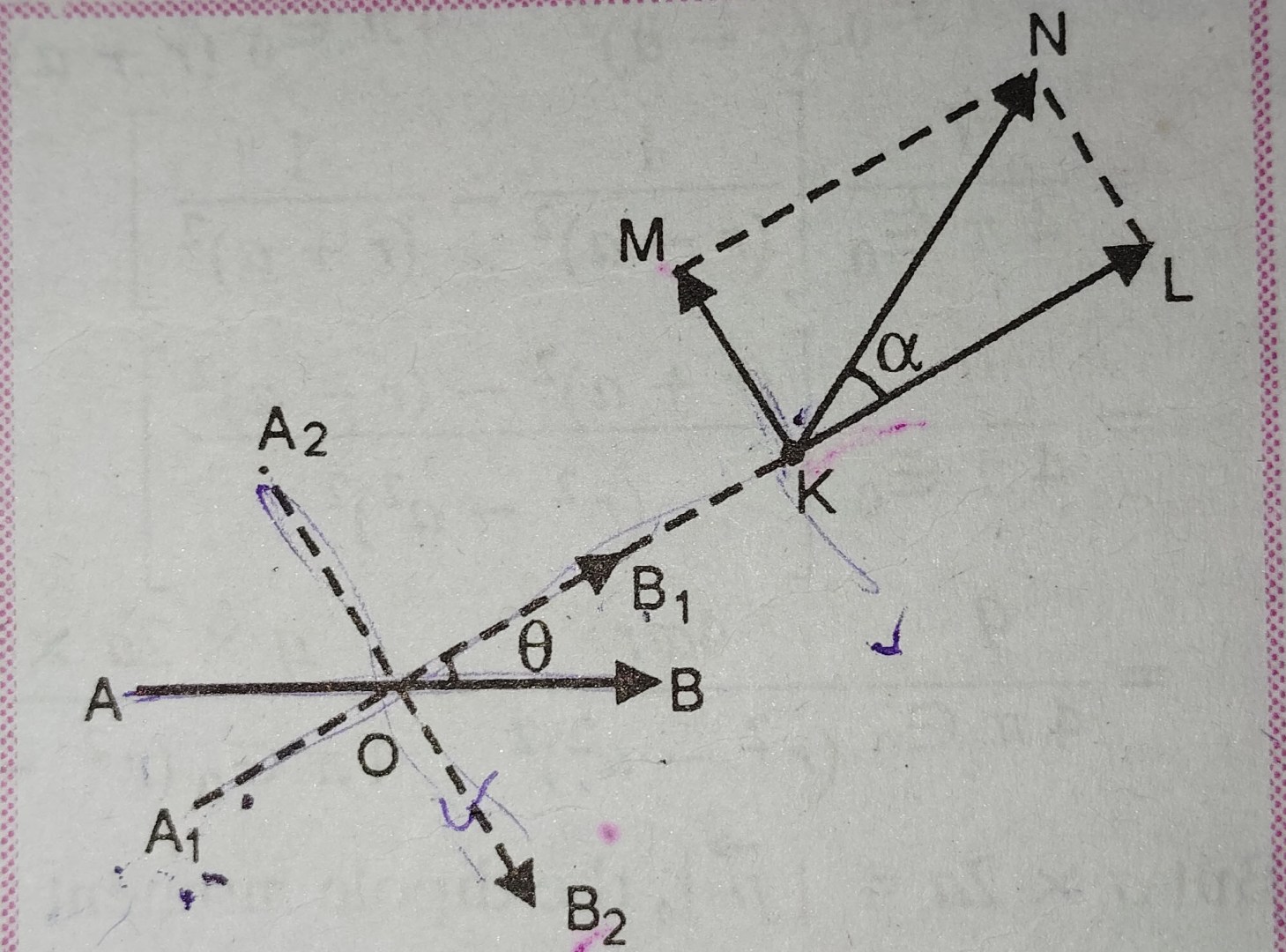
At any general point in space (not specifically on axial or equatorial line), the electric field intensity Edue to a short electric dipole at a distance r and at an angle θ from the dipole axis is given by:

Where:
- E = Electric field intensity
- p=q⋅2a = Dipole moment
- r = Distance from the center of the dipole to the point
- θ = Angle between the dipole axis and the position vector of the point
- ε0 = Permittivity of free space
This vector form gives both magnitude and direction of the electric field at any point in space around a short dipole.
Electric field intensity at any point on the axis of a uniformly charged ring
Electric Field Intensity at Any Point on the Axis of a Uniformly Charged Ring:

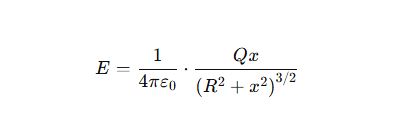
Consider a ring of radius R carrying total charge Q uniformly distributed along its circumference. The electric field intensity at a point on the axis of the ring (say, at distance x from the center) is given by:
Formula:
Direction:
- The electric field acts along the axis of the ring (away from the ring if Q>0, and toward the ring if Q<0
Where:
- E = Electric field intensity at axial point
- Q = Total charge uniformly distributed on the ring
- R = Radius of the ring
- x = Distance of the point from the center of the ring along the axis
- ε0 = Permittivity of free space
Key Insight:
- The field is maximum at a certain value of x=R/√2.
- At the center of the ring (x=0x = 0), the field is zero due to symmetry.
Torque on electric dipole in a uniform two dimensional electric field
Torque on Electric Dipole in a Uniform Two-Dimensional Electric Field:

When an electric dipole is placed in a uniform electric field, it experiences a torque that tries to rotate it so that it aligns with the field.
Formula:
τ=p×E
Or, in scalar form:
τ=pEsinθ
Where:
- τ= Torque on the dipole
- p=q.2a = Dipole moment vector
- E = Uniform electric field
- θ = Angle between pand E
Key Points:
- Torque tends to rotate the dipole to align with the electric field direction.
- When θ=0∘ or 180∘, τ=0 (no torque).
- Maximum torque occurs when θ=90∘, i.e., when dipole is perpendicular to the field.
This torque does not translate the dipole but only rotates it.
Potential energy of dipole in a uniform electric field
Potential Energy of Electric Dipole in a Uniform Electric Field:
When an electric dipole is placed in a uniform electric field, it possesses potential energy due to its orientation with respect to the field.
Formula:
U=−p.E=−pEcosθU
Where:
- U = Potential energy of the dipole
- p= Dipole moment
- E = Uniform electric field
- θ = Angle between p and E
Key Points:
- Minimum potential energy:
When θ=0∘, U=−pEU = -pE (dipole aligned with field) - Maximum potential energy:
When θ=180∘, U=+pEU = +pE (dipole opposite to field) - When θ=90∘ U=0U = 0
Thus, the dipole is most stable when aligned with the field (minimum energy), and unstable when opposite to the field (maximum energy).
Thanks For Learning !
Important Constants
| Quantity | Symbol | Value | SI Unit |
|---|---|---|---|
| Charge of Electron | qe | −1.6×10⁻¹⁹ | Coulomb (C) |
| Charge of Proton | qp | +1.6×10⁻¹⁹ | Coulomb (C) |
| Mass of Electron | me | 9.1×10⁻³¹ | kg |
| Mass of Proton | mp | 1.67×10⁻²⁷ | kg |
| Mass of Neutron | mn | 1.675×10⁻²⁷ | kg |
| Coulomb’s Constant | k | 9×10⁹ | N·m²/C² |
| Permittivity of Free Space | ε0 | 8.85×10⁻¹² | C²/N·m² |
| Relative Permittivity (Dielectric Constant) | εr | Varies (e.g., 1 for vacuum, ~80 for water) | Dimensionless |
| Speed of Light in Vacuum | cc | 3×10⁸ | m/s |
| Avogadro’s Number | NAN_A | 6.022×10²³ | mol⁻¹ |
| Planck’s Constant | hh | 6.626×10⁻³⁴ | J·s |
| Boltzmann Constant | kBk_B | 1.38×10⁻²³ | J/K |
| Universal Gravitational Constant | GG | 6.674×10⁻¹¹ | N·m²/kg² |
| Elementary Charge | ee | 1.602×10⁻¹⁹ | C |
Learn More

Electrostatic Potential and Capacitance
A Complete and powerful notes for quick revision
Keep reading
Class 12 Physics Chapterwise Most Important Questions with Answers
Get chapterwise most important questions and answers for CBSE Class 12 Physics based on the latest NCERT syllabus. Perfect for board exam preparation and last-minute revision.
Keep reading
Best Books For JEE Preparation (Mains and Advance)
Understanding JEE and the Importance of the Right Preparation Books IIT (Indian Institute of Technology): A Gateway to Global Opportunities The Indian Institutes of Technology (IITs) are among the most…
Keep readingSomething went wrong. Please refresh the page and/or try again.

 The Bachchantop
Leave a reply to Electrostatic Potential and Capacitance – The Bachchantop Cancel reply