
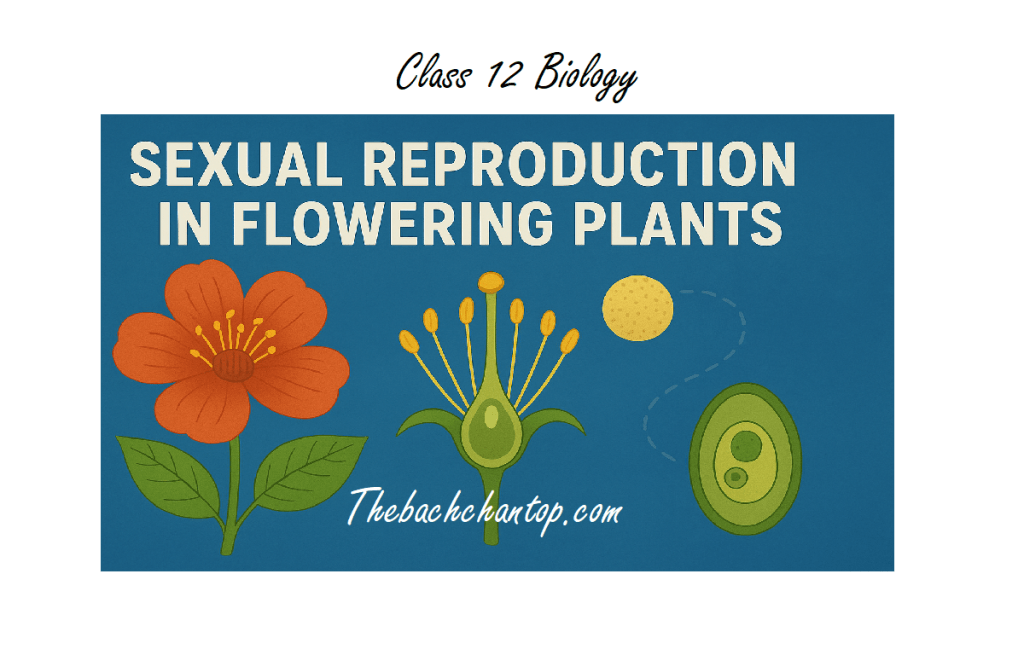
- Flower: The Site of Sexual Reproduction
- The Stamen (Microsporophyll)
- The Carpel (Megasporophyll) and the Ovule (Megasporangium)
- Pollination
- Pollen–Pistil Interaction
- Self-Incompatibility
- Emasculation and Bagging
- Fertilization
- Post-Fertilization Changes
- Apomixis and Polyembryony
Flower: The Site of Sexual Reproduction
- Definition:
A flower is the reproductive structure of angiosperms (flowering plants) where sexual reproduction occurs. - Importance:
- Produces gametes (male and female).
- Facilitates pollination and fertilization.
- Develops into fruits and seeds after fertilization.
- Origin:
- A flower develops from a floral bud at a specialized shoot called the floral axis.
Structure of the Flower
- Symmetry:
- Actinomorphic – Radially symmetrical (e.g., mustard).
- Zygomorphic – Bilaterally symmetrical (e.g., pea).
- Sex Distribution:
- Bisexual (Hermaphrodite) – Both stamens and carpels present (e.g., hibiscus).
- Unisexual – Either stamens or carpels present (e.g., papaya).
- Floral Parts Arrangement:
- Inserted on thalamus in concentric whorls.
- Main Whorls:
- Calyx – Outer whorl of sepals.
- Corolla – Whorl of petals.
- Androecium – Whorl of stamens (male reproductive part).
- Gynoecium – Whorl of carpels (female reproductive part).
Parts of a Typical Flower
- Pedicel – Stalk that supports the flower.
- Thalamus (Receptacle) – Swollen end of pedicel, holds floral whorls.
- Calyx (Sepals) –
- Usually green, leaf-like.
- Protects the bud in early stages.
- Corolla (Petals) –
- Often brightly colored to attract pollinators.
- Sometimes scented or nectar-producing.
- Androecium (Male Reproductive Organ) –
- Stamen – Consists of anther (pollen-producing) and filament (supports anther).
- Anther – Bilobed, each lobe with two pollen sacs containing pollen grains.
- Gynoecium (Female Reproductive Organ) –
- Made of carpels.
- Parts of Carpel:
- Stigma – Receives pollen.
- Style – Connects stigma to ovary.
- Ovary – Contains ovules (female gametophytes).
Functions of a Flower
- Reproduction: Produces male and female gametes for sexual reproduction.
- Pollination: Provides structures (e.g., nectar, petals) that aid in pollen transfer.
- Fertilization: Site where male and female gametes fuse to form a zygote.
- Fruit & Seed Formation: Ovary develops into fruit, ovules into seeds after fertilization.
- Genetic Variation: Enables cross-pollination, leading to variation in offspring.
The Stamen (Microsporophyll)
- Definition: The stamen is the male reproductive organ of a flower, also called the microsporophyll.
- Structure:
- Filament: Slender stalk that supports the anther.
- Anther: Usually bilobed; each lobe has two microsporangia (pollen sacs).
- Connective: Tissue connecting the two lobes of the anther.
- Function: Produces microspores (pollen grains) through microsporogenesis.
Development of Pollen Sacs (Microsporangia)
- Each young anther has four microsporangia – two in each lobe.
- Wall layers of microsporangium (from outer to inner):
- Epidermis – Protective outer layer.
- Endothecium – Assists in anther dehiscence.
- Middle Layers – 1–3 layers of thin-walled cells; degenerate in mature anther.
- Tapetum – Innermost nutritive layer; provides nourishment to developing pollen grains and secretes enzymes.
- Inside the microsporangium, microspore mother cells (MMC) are present, which undergo meiosis to form microspores.
Microsporogenesis
- Definition: Formation of microspores from microspore mother cells (MMC) by meiotic division.
- Process:
- Each MMC undergoes meiosis → produces a tetrad of four haploid microspores.
- Microspores are initially joined but later separate and develop into pollen grains.
- Significance: Ensures genetic variation through meiosis.
Dehiscence of Anther
- When pollen grains mature, the anther dries and the endothecium cells contract.
- This creates tension, leading to longitudinal splitting of the anther wall.
- Pollen grains are released for pollination.
Microspore and Pollen Grain
- Microspore: Young haploid cell formed after microsporogenesis; develops into a pollen grain.
- Pollen Grain Structure:
- Exine: Outer layer, made of sporopollenin (chemically inert, highly resistant).
- Intine: Inner layer, made of cellulose and pectin.
- Apertures: Thin areas in the exine (germ pores) for pollen tube emergence.
Fate of Pollen Grains after Their Dispersal
- Viability: Time for which pollen remains functional varies from minutes to months depending on species.
- Examples:
- Rice, wheat – 30 minutes.
- Some legumes – Several months.
- Examples:
- Factors affecting viability: temperature, humidity, storage conditions.
- Pollen may germinate on a compatible stigma or be lost if it fails to land on one.
Development of Male Gametophyte
- Pollen Grain Germination:
- Pollen grain lands on compatible stigma and absorbs water.
- Pollen tube emerges from germ pore and grows through style towards ovule.
- Pollen Grain Cell Division:
- In the anther: Microspore divides mitotically into two cells:
- Generative Cell – Smaller; later divides to form two male gametes.
- Vegetative (Tube) Cell – Larger; controls pollen tube growth.
- At the time of pollen release, it may be 2-celled (most species) or 3-celled (some species like lilies).
- In the anther: Microspore divides mitotically into two cells:
- Final Structure of Male Gametophyte:
- Tube cell + 2 male gametes enclosed within pollen tube.
The Carpel (Megasporophyll) and the Ovule (Megasporangium)
- Carpel: Female reproductive unit of a flower; also called megasporophyll.
- Parts of a Carpel:
- Stigma: Receives pollen.
- Style: Slender stalk connecting stigma to ovary.
- Ovary: Basal swollen part containing one or more ovules.
- Ovule (Megasporangium): Structure inside the ovary where megaspores and female gametophyte develop.
Structure of the Ovule
- Funicle: Stalk attaching ovule to ovary wall (placenta).
- Hilum: Junction between ovule and funicle.
- Integuments: Protective envelopes covering the ovule, leaving a small opening (micropyle).
- Micropyle: Opening through which pollen tube enters during fertilization.
- Nucellus: Mass of parenchymatous tissue enclosed by integuments; provides nutrition to developing embryo sac.
- Embryo Sac: Female gametophyte present inside nucellus.
- Chalaza: Opposite end of the micropyle; base of nucellus where integuments meet.
Types of Ovules (Based on position of micropyle with respect to funicle and chalaza)
- Orthotropous (Atropous): Micropyle, chalaza, and funicle in a straight line (e.g., Polygonum).
- Anatropous: Ovule inverted so that micropyle is near funicle; most common type (e.g., sunflower, mustard).
- Campylotropous: Ovule curved, embryo sac slightly curved (e.g., bean).
- Amphitropous: Ovule and embryo sac both curved (e.g., poppy).
- Circinotropous: Ovule turns over completely during development (e.g., Opuntia).
Megasporogenesis and Development of Female Gametophyte
- Megasporogenesis: Process of formation of megaspores from megaspore mother cell (MMC) inside the nucellus.
- Steps:
- A hypodermal cell differentiates into MMC (diploid).
- MMC undergoes meiosis → produces a linear tetrad of four haploid megaspores.
- In most angiosperms, only one megaspore (functional) survives; the other three degenerate.
- Development of Female Gametophyte (Embryo Sac):
- Functional megaspore undergoes three mitotic divisions → forms 8-nucleate, 7-celled embryo sac.
Structure of Monosporic Polygonum-type Embryo Sac
- Number of Cells/Nuclei: 7 cells, 8 nuclei.
- Arrangement:
- Egg Apparatus (at micropyle end):
- One Egg Cell – Haploid, fuses with male gamete to form zygote.
- Two Synergids – Help in guiding pollen tube to egg cell.
- Central Cell:
- Contains two polar nuclei (fuse with male gamete to form triploid primary endosperm nucleus).
- Antipodal Cells (at chalazal end): Three cells; often degenerate later.
- Egg Apparatus (at micropyle end):
- Polarity: Micropylar end (egg apparatus) and chalazal end (antipodals) are opposite ends of the embryo sac.
Pollination
- Definition: Transfer of pollen grains from the anther to the stigma of a flower.
- Types:
- Self-Pollination (Autogamy & Geitonogamy)
- Cross-Pollination (Xenogamy / Allogamy)
Self-Pollination
- Definition: Transfer of pollen from the anther to the stigma of the same flower (autogamy) or another flower on the same plant (geitonogamy).
- Adaptations for Self-Pollination:
- Bisexual flowers with anthers and stigma close together.
- Homogamy – Anther and stigma mature at the same time.
- Cleistogamy – Flowers never open, ensuring self-pollination (e.g., Viola, Oxalis).
- Advantages:
- Ensures reproduction when pollinators are scarce.
- Maintains parental traits (pure lines).
- Disadvantages:
- No genetic variation.
- Leads to inbreeding depression over time.
Cross-Pollination (Xenogamy / Allogamy)
- Definition: Transfer of pollen from the anther of one flower to the stigma of a flower on another plant of the same species.
- Adaptations for Cross-Pollination:
- Unisexual flowers (prevent self-pollination).
- Dichogamy – Male and female organs mature at different times.
- Self-incompatibility – Genetic mechanism preventing self-fertilization.
- Herkogamy – Physical barriers between anthers and stigma.
Anemophily (Wind Pollination)
- Examples: Maize, wheat, rice.
- Adaptations:
- Flowers small, inconspicuous, without nectar.
- Large quantity of light, dry pollen grains.
- Long, feathery stigmas to catch airborne pollen.
- Anthers well exposed for wind dispersal.
Hydrophily (Water Pollination)
- Examples: Vallisneria, Hydrilla, Zostera.
- Adaptations:
- Occurs in aquatic plants.
- Pollen grains are waterproof, often filamentous or elongated.
- In Vallisneria – Male flowers are released to float on the surface and meet female flowers.
Entomophily (Insect Pollination)
- Examples: Sunflower, orchids, salvia.
- Adaptations:
- Large, colorful, scented flowers.
- Nectar and edible pollen present.
- Sticky, spiny pollen grains to attach to insect bodies.
- Flower shape adapted to specific pollinators (e.g., orchid mimicry).
Ornithophily (Pollination by Birds)
- Examples: Hibiscus, coral tree, bottlebrush.
- Adaptations:
- Large, bright red or yellow flowers.
- Abundant nectar.
- Sturdy floral structures to withstand bird visits.
- Tubular corolla in many species.
Chiropterophily (Bat Pollination)
- Examples: Bauhinia, Kigelia (sausage tree).
- Adaptations:
- Large, dull-colored, night-blooming flowers.
- Strong fruity or fermented odor.
- Copious nectar and pollen.
- Robust flowers to withstand bat visits.
Advantages of Cross-Pollination
- Produces genetic variation, leading to adaptability and evolution.
- Offspring may be more vigorous and resistant to diseases.
- Reduces chances of inbreeding depression.
- Allows beneficial recombination of traits.
Pollen–Pistil Interaction
- Definition: A sequence of events and biochemical interactions between the pollen grain (male gametophyte) and the pistil (female reproductive organ) that determines compatibility and leads to successful fertilization.
- Importance:
- Ensures that only compatible pollen grains germinate.
- Prevents wasteful fertilization by incompatible pollen.
Steps in Pollen–Pistil Interaction
- Pollen Deposition on Stigma
- Pollen grains land on the stigma through agents like wind, water, insects, birds, or bats.
- Recognition and Acceptance/Rejection
- The stigma surface has specific proteins and biochemical signals to identify pollen.
- Compatible pollen is accepted and germinates.
- Incompatible pollen is rejected by self-incompatibility mechanisms (genetic).
- Pollen Germination
- In compatible interaction, the pollen grain hydrates by absorbing water and nutrients from the stigma.
- Pollen tube emerges through the germ pore in the exine.
- Pollen Tube Growth through Style
- Pollen tube grows within the style tissue, guided by chemical signals from the ovule.
- Vegetative (tube) cell controls tube growth; generative cell divides to form two male gametes.
- Guidance to the Ovule
- Synergids in the embryo sac secrete attractants to guide pollen tube to the micropyle.
- Entry into Ovule
- Pollen tube enters through micropyle (porogamy), chalaza (chalazogamy), or integument (mesogamy) depending on species.
Mechanisms of Self-Incompatibility
- Definition: Inability of a plant to produce seeds after self-pollination due to genetic control.
- Types:
- Gametophytic Self-Incompatibility – Pollen compatibility determined by the genetic makeup of the pollen grain.
- Sporophytic Self-Incompatibility – Determined by the genotype of the parent plant producing the pollen.
- Function: Promotes outbreeding and genetic diversity.
End Result of Successful Pollen–Pistil Interaction
- Delivery of two male gametes into the embryo sac:
- One fuses with egg cell (syngamy) to form zygote.
- Other fuses with polar nuclei (triple fusion) to form primary endosperm nucleus.
Self-Incompatibility
- Definition: A genetic mechanism in flowering plants that prevents self-fertilization by inhibiting the germination of self-pollen or the growth of its pollen tube on the stigma/style of the same plant.
- Purpose:
- Promotes cross-pollination (outbreeding).
- Maintains genetic diversity within a species.
Types of Self-Incompatibility
- Gametophytic Self-Incompatibility (GSI)
- Pollen compatibility is determined by the genetic makeup of the pollen grain (haploid genotype).
- Example: In Nicotiana (tobacco), Petunia.
- If the pollen’s S-allele matches any S-allele in the pistil, pollen tube growth is inhibited in the style.
- Sporophytic Self-Incompatibility (SSI)
- Pollen compatibility is determined by the genotype of the parent plant (diploid sporophyte) that produced it.
- Example: In Brassica (mustard family).
- If the S-allele of the pollen parent matches the pistil, pollen fails to germinate on the stigma surface.
Mechanism of Action
- Recognition between pollen and stigma involves S-gene complex.
- Incompatible pollen:
- Either fails to germinate on stigma (surface inhibition).
- Or pollen tube growth stops within style before reaching ovule.
- Compatible pollen:
- Germinates and pollen tube reaches embryo sac for fertilization.
Significance of Self-Incompatibility
- Prevents inbreeding and inbreeding depression.
- Encourages genetic recombination.
- Increases adaptability and evolutionary potential of species.
Overcoming Self-Incompatibility
- Bud Pollination: Pollinating flowers before stigma receptivity.
- Mentor Pollen: Mixing compatible pollen with irradiated incompatible pollen.
- Use of Growth Regulators: Spraying hormones like gibberellins or cytokinins to bypass inhibition.
- In Vitro Fertilization: Culturing pollen tubes directly on ovules under lab conditions.
Emasculation and Bagging
Emasculation
- Definition: Removal of stamens (male reproductive parts) from a flower before the anthers mature and release pollen.
- Purpose:
- Prevents self-pollination in bisexual flowers.
- Ensures that only desired pollen from a selected male parent is used for pollination.
- Method:
- Done with forceps or scissors in young buds when anthers are immature.
- Care is taken not to damage the gynoecium.
- Used In:
- Artificial hybridization experiments.
- Plant breeding programs.
Bagging
- Definition: Covering the emasculated flower with a suitable bag (butter paper, polythene, or cloth) to prevent unwanted pollen contamination.
- Purpose:
- Protects stigma from foreign or unwanted pollen until desired pollen is introduced.
- Maintains controlled pollination conditions.
- Process:
- After emasculation, immediately cover the flower with a bag.
- When stigma becomes receptive, remove bag partially.
- Dust desired pollen on stigma.
- Re-bag the flower until fertilization is assured.
Importance in Plant Breeding
- Ensures purity of cross in hybridization experiments.
- Prevents accidental pollination by wind or insects.
- Helps in producing desired crop varieties with specific traits.
Fertilization
- Definition: The fusion of male and female gametes to form a zygote in sexual reproduction.
- In flowering plants, fertilization occurs inside the ovule after the pollen tube delivers the male gametes.
- It involves three key stages: growth of pollen tube, entry into ovule, and double fertilization.
Growth of the Pollen Tube
- After pollination and pollen–pistil compatibility:
- Pollen grain germination – absorbs water and nutrients from stigma.
- Pollen tube formation – emerges from germ pore of pollen grain.
- Guided growth – tube grows through style tissues towards ovary, guided by chemical attractants from ovule.
- Cell division inside pollen grain – generative cell divides to form two male gametes; vegetative cell remains at tip of tube controlling growth.
Entry of the Pollen Tube into the Ovule
- Pollen tube enters ovule through one of three possible routes:
- Porogamy – Entry through micropyle (most common).
- Chalazogamy – Entry through chalaza (rare).
- Mesogamy – Entry through integuments (rare).
- Tube penetrates one of the synergids of the embryo sac and releases two male gametes.
Double Fertilization
- Definition: A unique feature of angiosperms where two fertilization events occur in the same embryo sac.
- Process:
- Syngamy – One male gamete fuses with egg cell → forms zygote (2n).
- Triple Fusion – Other male gamete fuses with two polar nuclei in central cell → forms primary endosperm nucleus (PEN, 3n).
- Significance:
- Zygote develops into embryo.
- PEN develops into endosperm, which nourishes the developing embryo.
- End Result: Both embryo and endosperm are formed in the same process, ensuring efficient reproduction.
Post-Fertilization Changes
Development of Endosperm
- Endosperm is a nutritive tissue that supports the developing embryo.
- It develops from the primary endosperm nucleus (PEN) formed after the fusion of a male gamete with the two polar nuclei during double fertilization.
- Types of endosperm development:
- Nuclear type – Free nuclear divisions without wall formation initially (e.g., coconut water).
- Cellular type – Wall formation occurs after each nuclear division (e.g., Petunia).
- Helobial type – Combination of nuclear and cellular types (e.g., Asphodelus).
- In some plants, endosperm persists in the mature seed (albuminous seeds like castor, maize), while in others it is completely absorbed (exalbuminous seeds like pea, bean).
Development of Embryo (Embryogeny)
- The zygote formed after fertilization develops into an embryo.
- Early stages involve cell divisions and differentiation into suspensor (anchors embryo to endosperm) and embryonal mass (forms main plant body).
- The embryo passes through stages like proembryo → globular → heart-shaped → torpedo-shaped before maturing.
- Different patterns of embryogeny are seen in monocots and dicots:
- Dicots – Two cotyledons (e.g., bean).
- Monocots – Single cotyledon (scutellum) (e.g., maize).
Development of Seed
- Seeds form from fertilized ovules.
- Components of a mature seed: seed coat (testa and tegmen), embryo, and sometimes endosperm.
- Seeds can be albuminous or exalbuminous depending on endosperm persistence.
- Function: Protection of embryo, dispersal, and survival during unfavorable conditions.
Development of Fruits
- Fruits form from the ovary after fertilization.
- True fruits – Develop from ovary only (e.g., mango, pea).
- False fruits – Develop from ovary along with other floral parts (e.g., apple from thalamus).
- Parthenocarpic fruits – Develop without fertilization; seedless (e.g., banana).
- Fruits aid in seed dispersal via wind, water, animals, or mechanical means.
Apomixis and Polyembryony
1. Apomixis
- Definition – Apomixis is the process of seed formation without fertilization, i.e., without the fusion of male and female gametes.
- Key features –
- Seeds are produced without meiosis and fertilization.
- Offspring are genetically identical to the parent (clones).
- Types of Apomixis –
- Asexual reproduction through seeds – no gamete fusion occurs.
- Agamospermy – seeds are formed without fertilization.
- Adventive embryony – embryo develops directly from diploid cells like nucellus or integuments.
- Diplospory – embryo sac develops from diploid megaspore mother cell without meiosis.
- Apospory – embryo sac develops from diploid nucellar cells instead of the megaspore.
- Significance –
- Produces uniform and stable traits.
- Maintains hybrid vigour (heterosis).
- Useful in agriculture for producing true-to-type plants.
2. Polyembryony
- Definition – The occurrence of more than one embryo in a single seed.
- Causes –
- Development of multiple embryos from different embryo sacs in the same ovule.
- Formation of extra embryos from synergids, antipodal cells, nucellus, or integuments.
- Cleavage of the zygote into multiple parts, each developing into an embryo.
- Types –
- True polyembryony – multiple embryos arise naturally in the seed.
- False polyembryony – more than one seed appears fused together.
- Examples – Citrus, Mango, Onion.
- Importance –
- Ensures better chances of seedling survival.
- Can be exploited in plant breeding and horticulture.

 The Bachchantop
Leave a reply to कक्षा 12 जीवविज्ञान अध्याय 1 – पुष्पीय पौधों में लैंगिक जनन नोट्स PDF (फ्री डाउनलोड) – The Bachchantop Cancel reply