
Introduction
Living organisms show similarities with their parents, yet they are not exactly identical. This happens because of heredity, while gradual changes occurring over generations lead to evolution. These two concepts explain how traits are inherited and how life changes over long periods.
Understanding heredity and evolution helps explain biodiversity and the development of different organisms on Earth.
What is Heredity?
Heredity is the process by which characteristics are transferred from parents to offspring through genes.
Important Points
- Heredity ensures continuity of species.
- Traits are inherited through DNA and genes.
- Offspring resemble parents because of heredity.
- Both physical and some biological characteristics are inherited.
- Variation also occurs during inheritance.
Examples of Hereditary Traits
- Eye colour
- Height
- Hair texture
- Blood group
- Shape of leaves in plants

What is Evolution?
Evolution is the gradual change in inherited characteristics of populations over many generations.
Important Points
- Evolution occurs over a long period.
- It leads to formation of new species.
- Variations help organisms survive.
- Evolution explains diversity among living organisms.
- Natural selection plays an important role.
Examples of Evolution
- Development of modern humans.
- Evolution of birds from ancient reptiles.
- Changes in beak shape of birds according to food availability.
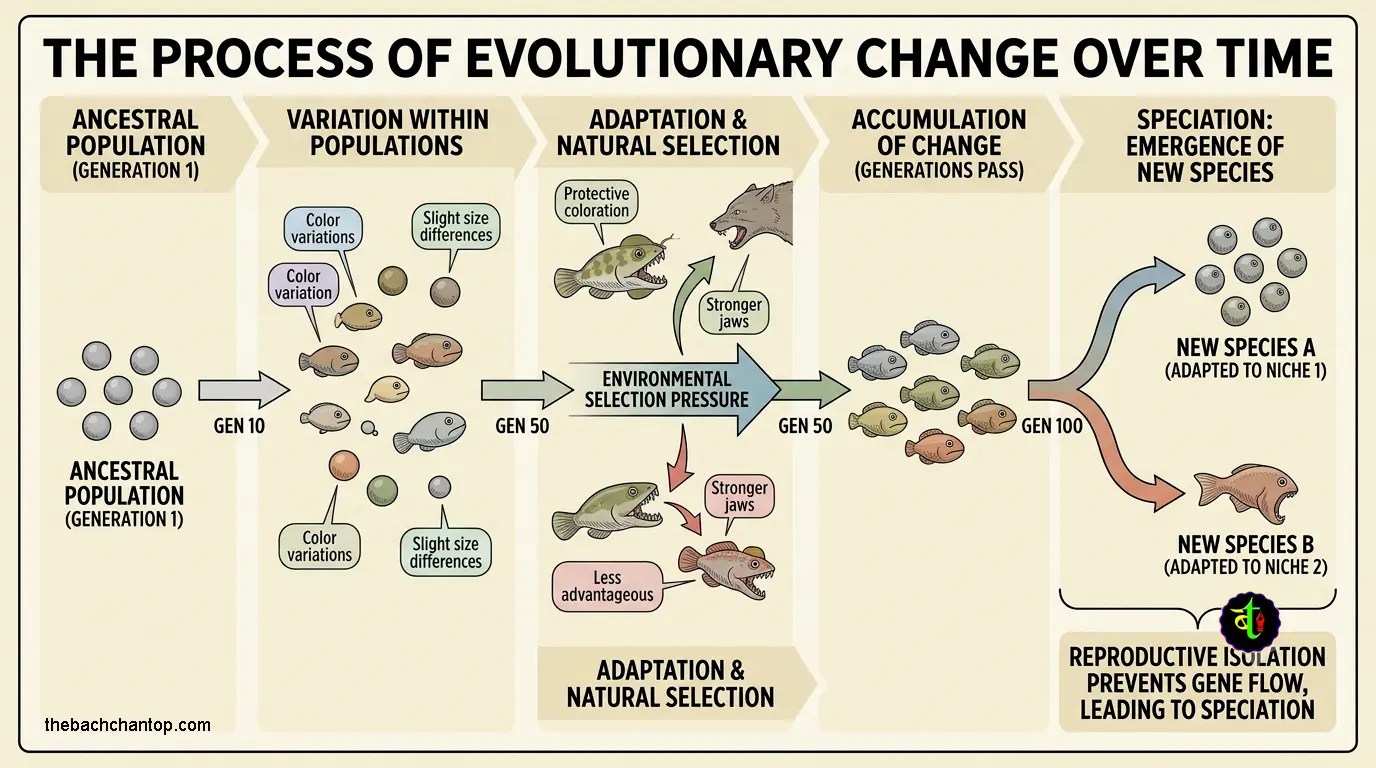
Relationship Between Heredity and Evolution
| Heredity | Evolution |
|---|---|
| Transfers traits from parents to offspring | Produces gradual changes across generations |
| Works through genes | Works through accumulated variations |
| Acts within a generation | Acts over long periods |
| Maintains continuity | Creates diversity |
Simple Understanding
- Heredity passes traits.
- Evolution changes populations over time.
- Variations inherited through heredity become the raw material for evolution.
Difference Between Heredity and Evolution
| Basis | Heredity | Evolution |
|---|---|---|
| Definition | Transfer of traits | Gradual change in species |
| Time Period | Immediate generation | Many generations |
| Unit Involved | Individual offspring | Population |
| Cause | Genes and DNA | Variation and natural selection |
| Result | Similarity with parents | Formation of diversity |
How Variation Connects Heredity and Evolution
Variation means small differences among individuals.
Sources of Variation
- Genetic recombination
- Mutation
- Sexual reproduction
- Environmental influence
Importance of Variation
- Helps organisms adapt.
- Increases survival chances.
- Supports evolution.

NCERT-Based Key Concepts
Acquired Traits
Traits developed during life are usually not inherited.
Example:
- Bodybuilding muscles
- Pierced ears
Inherited Traits
Traits controlled by genes and transferred to offspring.
Example:
- Blood group
- Eye colour
Importance of Studying Heredity and Evolution
- Explains origin of diversity.
- Helps in genetics and medicine.
- Supports crop improvement.
- Helps understand adaptation.

Practice Questions
Very Short Answer Questions
1. What is heredity?
Answer: Transfer of traits from parents to offspring.
2. Define evolution.
Answer: Gradual change in inherited characteristics over generations.
3. What is variation?
Answer: Differences among individuals of the same species.
4. Are acquired traits inherited?
Answer: No.
5. What carries hereditary information?
Answer: Genes present in DNA.
Short Answer Questions
1. How are heredity and evolution related?
Answer: Heredity transfers variations to offspring, and accumulation of variations leads to evolution.
2. Why is variation important?
Answer: It helps organisms adapt and survive environmental changes.
3. Explain inherited and acquired traits.
Answer:
Inherited traits are passed through genes, while acquired traits develop during life and are generally not inherited.
Fill in the Blanks
- Transfer of traits is called Heredity.
- Evolution occurs over many generations.
- Traits are controlled by genes.
- Differences among individuals are called variations.
- Evolution leads to formation of new species.
MCQs (With Answers)
1. Transfer of traits occurs through:
A. Muscles
B. Genes
C. Bones
D. Food
Answer: B
2. Evolution mainly occurs in:
A. One organism
B. Population
C. Cell
D. Tissue
Answer: B
3. Which trait is inherited?
A. Burn marks
B. Height
C. Tattoo
D. Hairstyle
Answer: B
4. Variation helps in:
A. Extinction
B. Survival
C. Digestion
D. Respiration
Answer: B
5. Heredity occurs through:
A. DNA
B. Water
C. Soil
D. Food
Answer: A
6. Evolution takes place over:
A. Minutes
B. Days
C. Generations
D. Hours
Answer: C
7. New species arise due to:
A. Evolution
B. Digestion
C. Circulation
D. Respiration
Answer: A
8. Which is not inherited?
A. Blood group
B. Eye colour
C. Pierced ear
D. Hair type
Answer: C
9. Basic unit of heredity:
A. Gene
B. Bone
C. Tissue
D. Cell
Answer: A
10. Evolution results in:
A. Uniformity
B. Diversity
C. No change
D. Extinction only
Answer: B
Quick Revision
- Heredity → Transfer of traits
- Variation → Differences among individuals
- Evolution → Long-term change in populations
- Variation + Selection → Evolution
NCERT Summary: Heredity explains continuity, while evolution explains diversity.


